
Transplante em alopecias cicatriciais
Dra. Leila Bloch

As alopecias cicatriciais (AC) são condições em que há destruição permanente dos folículos capilares com substituição por tecido fibroso. Classificam-se em primárias (ACP) quando há destruição do folículo capilar por um mecanismo inflamatório desconhecido. Há quatro principais subtipos de ACP baseados na resposta inflamatória perifolicular: neutrofílica, linfocítica, mista e inespecífica. As alopecias cicatriciais secundárias (ACS), porém, decorrem de destruição do folículo por uma causa não relacionada diretamente a ele, como queimaduras, neoplasias, infecções, trauma ou radiação.
O transplante capilar é uma possibilidade no tratamento de casos avançados de AC, que afetam bastante a autoestima dos pacientes.
O tratamento atual das ACP tem como objetivo reduzir ou inibir a progressão da doença através de corticoides tópicos, infiltração intralesional de triancinolona acetonida, antibióticos, retinóides, hidroxicloroquina e outros. Porém, não há ainda protocolos bem estabelecidos sobre os transplantes capilares nas ACP. Recomenda-se aproximadamente dois anos de estabilidade clínica, no entanto, ainda sem evidências robustas. Não há consenso em relação à realização de cirurgia em área teste previamente ao transplante, já que a redução de sobrevivência dos enxertos ocorre após dois anos do transplante. Também não há definição em relação ao tratamento medicamentoso posterior à cirurgia.
Uma revisão sistemática de 2019 constatou que o transplante capilar pode ser uma opção viável para Alopecia Cicatricial Central Centrífuga, esclerodermia linear "em golpe de sabre", lúpus discóide, pseudopelada de Brocq e foliculite decalvante, enquanto que para Líquen Plano Pilar (LPP) e Alopecia Frontal Fibrosante (AFF) foram encontrados resultados positivos e negativos. O parâmetro de dois anos de remissão clínica não foi fundamentado nessa revisão. A taxa de sobrevivência do enxerto foi de 50% em comparação a 90% nas não cicatriciais. Vale ressaltar a possível interferência do viés de relato positivo.
Em revisão multicêntrica de 2019 com pacientes com AFF submetidos a transplante capilar, verificou-se redução da sobrevivência do enxerto independente do período de remissão clínica. O resultado do transplante capilar em pacientes com AFF foi temporário, ainda que houvesse manutenção da terapia medicamentosa. A satisfação dos pacientes foi alta, mas foi recomendada discussão cuidadosa sobre a duração dos resultados.
Uma revisão sistemática de 2021 concluiu que o transplante capilar é viável em pacientes com AFF e com LPP, porém com resultados menos favoráveis em comparação a outras alopecias cicatriciais.
Em relação às ACS, ainda que haja poucas publicações sobre o tema, sabe-se que não há necessidade de preocupação em relação à estabilidade do quadro clínico. Verificou-se que a rigidez da cicatriz (por atrofia, hipertrofia e fibrose) com perfusão sanguínea reduzida torna a taxa de sobrevivência das UF entre 70 a 90%, inferior aos 95% encontrados em couros cabeludos normais.
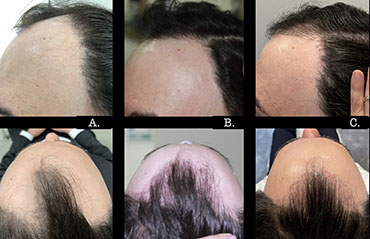
Figura 1: AFF em paciente do sexo masculino, 42 anos, com alopecia frontal fibrosante que se manteve em seguimento desde 2016 em tratamento clínico com hidroxicloroquina, dutasterida. A. Quadro clínico antes da cirurgia. B. Foi submetido a transplante capilar em agosto de 2019, por técnica FUT, com desenho conservador, sendo transplantados 5267 fios com repilação abaixo da média em cerca de 15%. Resultado clínico 1 ano após o transplante. C. Paciente manteve-se em tratamento clínico com hidroxicloroquina, dutasterida, minoxidil oral e corticoide tópico. Evoluiu com redução de densidade capilar da área transplantada, mais evidente após dois anos e meio da cirurgia, com cerca de 15% de redução de densidade, mas se manteve bastante satisfeito com o resultado.
Referências
- Ekelem C, Pham C, Atanaskova Mesinkovska N. A Systematic Review of the Outcome of Hair Transplantation in Primary Scarring Alopecia. Skin Appendage Disord. 2019 Feb;5(2):65-71.
- Vañó-Galván S, Villodres E, Pigem R, Navarro-Belmonte MR, Asín-Llorca M, Meyer-González T, Rodrigues-Barata R, Moreno-Arrones ÓM, Saceda-Corralo D, Bouhanna P, Camps A. Hair transplant in frontal fibrosing alopecia: A multicenter review of 51 patients. J Am Acad Dermatol. 2019 Sep;81(3):865-866.
- Lee JA, Levy DA, Patel KG, Brennan E, Oyer SL. Hair Transplantation in Frontal Fibrosing Alopecia and Lichen Planopilaris: A Systematic Review. Laryngoscope. 2021 Jan;131(1):59-66.
- Martinez, D.d.A.e.S., Sodré, J.L., Regis, J.R., Barreto, T.d.M., Santos, L.D.N., Müller Ramos, P., Frattini, S., Weffort, F. and Melo, D.F. (2022), Hair transplantation in uncommon secondary cicatricial alopecias. Dermatologic Therapy, 35: e15592.
- Yoo H, Moh J, Park JU. Treatment of Postsurgical Scalp Scar Deformity Using Follicular Unit Hair Transplantation. Biomed Res Int. 2019 May 13;2019:3423657. doi: 10.1155/2019/3423657.
- Jiménez F, Poblet E. Is hair transplantation indicated in frontal fibrosing alopecia? The results of test grafting in three patients. Dermatol Surg. 2013 Jul;39(7):1115-8.
English version
Transplant in cicatricial alopecia
Transplant in cicatricial alopecia
Dr. Leila Bloch
Cicatricial alopecia (CA) is a condition in which there is permanent destruction of hair follicles with replacement by fibrous tissue. They are classified as primary (PCA) when there is destruction of the hair follicle by an unknown inflammatory mechanism. There are four main subtypes of PCA based on the perifollicular inflammatory response: neutrophilic, lymphocytic, mixed, and nonspecific. However, secondary cicatricial alopecia (SCA) results from destruction of the follicle by a cause not related to it, such as burns, neoplasms, infections, trauma, or radiation.
Hair transplant is a possibility in the treatment of advanced cases of CA, which affect patients' self-esteem.
Current treatment of PCA aims to reduce or inhibit the progression of the disease through topical corticosteroids, intralesional infiltration of triamcinolone acetonide, antibiotics, retinoids, hydroxychloroquine, and others. However, there are still no well-established protocols regarding hair transplants in PCA. Approximately two years of clinical stability are recommended; however, there is still no robust evidence. There is no consensus regarding performing surgery in a test area prior to transplant, as the reduction in graft survival occurs two years after the procedure. There is also no definition regarding drug treatment after surgery.
A 2019 systematic review found that hair transplant may be a viable option for Centrifugal Central Cicatricial Alopecia, coup-de-sabre linear scleroderma, discoid lupus, Pseudopelade of Brocq, and folliculitis decalvans, while for Lichen Planus Pilaris (LPP) and Frontal Fibrosing Alopecia (FFA) positive and negative results were found. The parameter of two years of clinical remission was not substantiated in this review. The graft survival rate was 50% compared to 90% in non-scarring. It is worth highlighting the possible interference of positive reporting bias.
In a 2019 multicenter review of patients with AFF who underwent hair transplant, a reduction in graft survival was found regardless of the period of clinical remission. The result of hair transplantation in patients with AFF was temporary, even if drug therapy was maintained. Patient satisfaction was high, but careful discussion about the duration of results was recommended.
A 2021 systematic review concluded that hair transplant is feasible in patients with AFF and LPP, but with less favorable results compared to other cicatricial alopecia.
In relation to SCA, even though there are few publications on the topic, it is known that there is no need to worry about the stability of the clinical picture. It was found that the stiffness of the scar (due to atrophy, hypertrophy, and fibrosis) with reduced blood perfusion makes the UF survival rate between 70 and 90%, lower than the 95% found in normal scalps.
Figure 1: AFF in a 42-year-old male patient with frontal fibrosing alopecia who has been followed up since 2016 under clinical treatment with hydroxychloroquine and dutasteride. A. Clinical condition before surgery. B. He underwent a hair transplant in August 2019, using the FUT technique, with a conservative design, with 5267 hairs transplanted with below-average hair removal of around 15%. Clinical outcome one year after transplantation. C. Patient remained on clinical treatment with hydroxychloroquine, dutasteride, oral minoxidil and topical corticosteroids. He progressed with a reduction in hair density in the transplanted area, more evident two and a half years after surgery, with around 15% reduction in density, but he remained quite satisfied with the result.
References
- Ekelem C, Pham C, Atanaskova Mesinkovska N. A Systematic Review of the Outcome of Hair Transplantation in Primary Scarring Alopecia. Skin Appendage Disord. 2019 Feb;5(2):65-71.
- Vañó-Galván S, Villodres E, Pigem R, Navarro-Belmonte MR, Asín-Llorca M, Meyer-González T, Rodrigues-Barata R, Moreno-Arrones ÓM, Saceda-Corralo D, Bouhanna P, Camps A. Hair transplant in frontal fibrosing alopecia: A multicenter review of 51 patients. J Am Acad Dermatol. 2019 Sep;81(3):865-866.
- Lee JA, Levy DA, Patel KG, Brennan E, Oyer SL. Hair Transplantation in Frontal Fibrosing Alopecia and Lichen Planopilaris: A Systematic Review. Laryngoscope. 2021 Jan;131(1):59-66.
- Martinez, D.d.A.e.S., Sodré, J.L., Regis, J.R., Barreto, T.d.M., Santos, L.D.N., Müller Ramos, P., Frattini, S., Weffort, F. and Melo, D.F. (2022), Hair transplantation in uncommon secondary cicatricial alopecias. Dermatologic Therapy, 35: e15592.
- Yoo H, Moh J, Park JU. Treatment of Postsurgical Scalp Scar Deformity Using Follicular Unit Hair Transplantation. Biomed Res Int. 2019 May 13;2019:3423657. doi: 10.1155/2019/3423657.
- Jiménez F, Poblet E. Is hair transplantation indicated in frontal fibrosing alopecia? The results of test grafting in three patients. Dermatol Surg. 2013 Jul;39(7):1115-8.

