
Transplante de supercílios em pacientes com AFF: é arriscado? Está correto?
Dra. Anna Cecília Andriolo
Dermatologista
Prática Profissionalizante em Tricoses pela FMUSP
Membro da SBD, SBCD, ABCRC e AHRS
Tesoureira da diretoria atual da ABCRC – 2021/2022
A alopecia frontal fibrosante (AFF) é uma alopecia cicatricial primária linfocítica caracterizada pela perda progressiva da linha frontotemporal e das sobrancelhas.
A perda de sobrancelhas é descrita na literatura em cerca de 75 a 94% dos pacientes com AFF e leva a uma diminuição importante da qualidade de vida destes pacientes, que buscam auxílio nos consultórios dermatológicos e de cirurgiões plásticos.
Em até 39% dos casos pode preceder a perda de fios no couro cabeludo, portanto o exame das sobrancelhas pode auxiliar de forma importante o diagnóstico precoce na AFF.
Clinicamente, o envolvimento das sobrancelhas é considerado não inflamatório e não cicatricial, com ausência de eritema e descamação perifolicular e pápulas. Eritema difuso e discromías (hipopigmentação) podem ser observados em alguns casos.
Anzai A. e colaboradores estudaram a tricoscopia das sobrancelhas de pacientes com AFF e os principais achados foram: pontos amarelos (92,7%), múltiplos pontos brancos pequenos (79,5%), fios velos (76,2%), pontos pretos (66,2%) e pelos distróficos (60,9%). Estes achados tricoscópicos também são compatíveis com a clínica não inflamatória e não cicatricial, e um alerta deve ser dado para que esses achados na sobrancelha não atrapalhem (atrasem ou confundam) o diagnóstico da AFF, uma doença cicatricial no couro cabeludo.
Embora tenhamos a presença de sinais não cicatriciais, o tratamento clínico da AFF não leva ao crescimento dos pelos das sobrancelhas e os pacientes se utilizam de técnicas de camuflagem (micropigmentação e maquiagem) ou procuram pelo transplante de fios nessa região.
Embora o transplante de sobrancelhas seja um procedimento bem aceito na comunidade médica e entre os pacientes, com excelentes resultados cosméticos e duradouros quando indicados em situações de trauma (queimadura, cicatrizes, excesso de manipulação), quase não encontramos literatura publicada sobre sua eficácia na AFF.
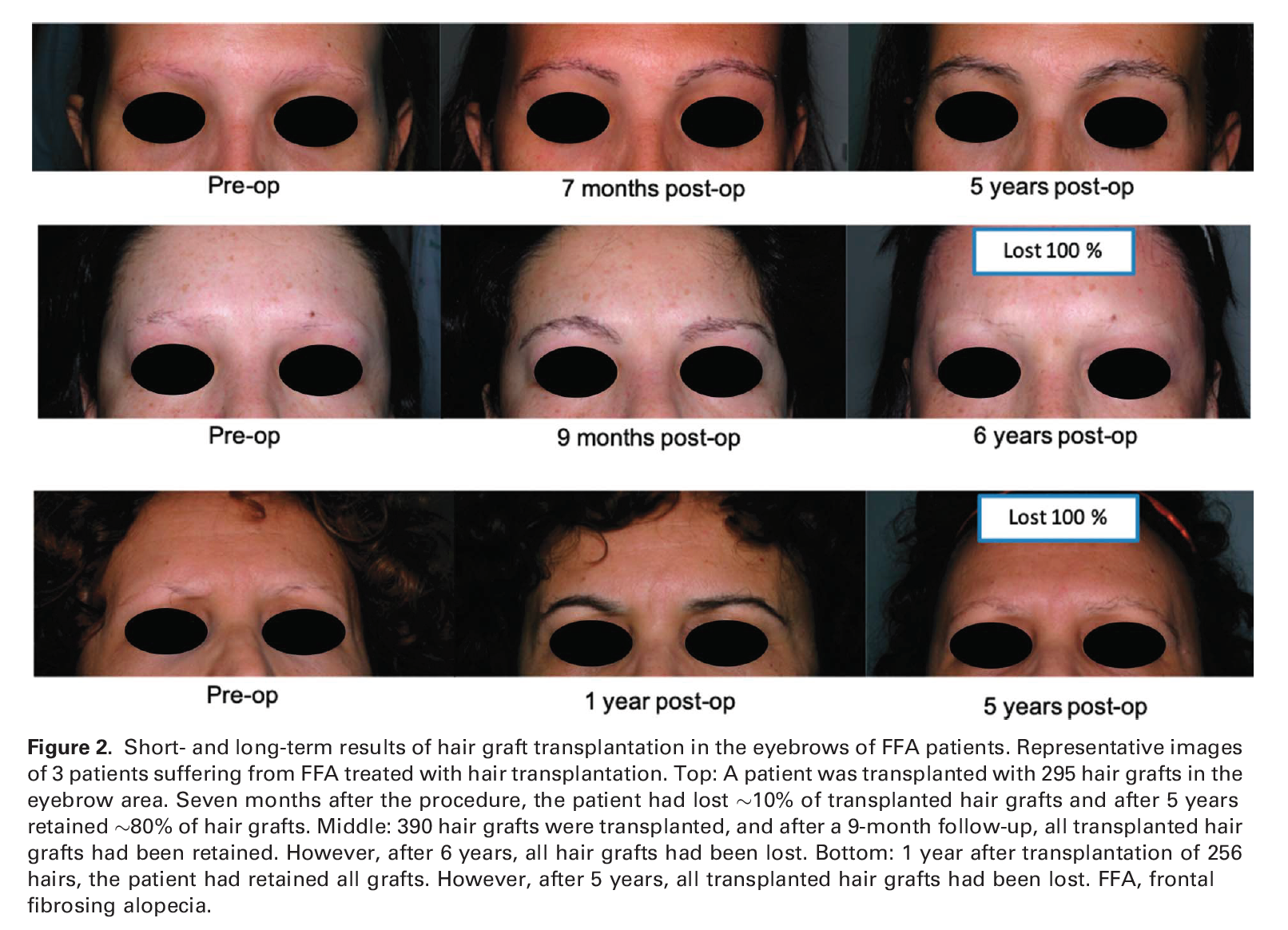
Audickaite A. e colaboradores, em 2019, apresentam o resultado de 10 pacientes (9 mulheres e 1 homem) com AFF (a maioria cursando tratamento clínico), submetidos ao transplante de sobrancelhas pela técnica de FUT ou FUE. Todos os pacientes foram advertidos do risco de perda de enxertos pelo caráter inflamatório da doença e, apesar disso, optaram por realizar o procedimento.
Dos 10 pacientes, 8 obtiveram um crescimento normal nos primeiros 12 - 24 meses; 4 desses foram seguidos por mais de 3 anos sendo que 3 apresentaram perda lenta e progressiva dos fios e apenas 1 obteve um excelente resultado após 4 anos de doença.
Existe uma discussão sobre o momento ideal para realizar a cirurgia nos pacientes com AFF. Embora defenda-se que esse momento seja após 2 anos de remissão medicamentosa da doença, não temos marcadores sensíveis e acurados para garantir que a doença esteja estabilizada. Sabemos também que a história natural da AFF envolve longos períodos de remissão e reativação e não podemos garantir que o período de remissão seja permanente. Além disso, o próprio trauma da cirurgia pode reativar a doença.
Chegamos então à grande questão: é correto transplantar supercílios na AFF? É arriscado?
Frente à literatura sobre transplante capilar em pacientes com AFF (seja supercílios ou couro cabeludo) e segundo observações minhas e de colegas próximos, notamos que quando bem orientados sobre as possíveis perdas dos enxertos ao longo dos anos (caráter temporário do transplante), a maioria dos pacientes prefere se submeter ao procedimento cirúrgico. Isso acontece devido ao elevado nível de satisfação decorrente da melhora rápida da aparência e do ganho na autoestima, que suplantam a perda variável de folículos que começa normalmente após 2 anos da cirurgia.
Cada vez mais ressaltamos a importância de um bom relacionamento médico-paciente e do alinhamento prévio das expectativas frente a cada caso cirúrgico.
Referências Bibliográficas:
1- Anzai A, Pirmez R, Vincenzi C, Fabbrocini G, Romiti R, Tosti A. Trichoscopy findings of frontal fibrosing alopecia on the eyebrows: A study of 151 cases. J Am Acad Dermatol. 2021 Nov;85(5):1130-1134. doi: 10.1016/j.jaad.2019.12.023. Epub 2019 Dec 17. PMID: 31857108.
2- Salas-Callo CI, Cajas-García MS, Pirmez R. Hypopigmentation of the Eyebrows in Frontal Fibrosing Alopecia. Skin Appendage Disord. 2021 Apr;7(3):243-245. doi: 10.1159/000512866. Epub 2021 Feb 10. PMID: 34055918; PMCID: PMC8138258
3- Audickaite A, Alam M, Jimenez F. Eyebrow Hair Transplantation in Frontal Fibrosing Alopecia: Pitfalls of Short- and Long-Term Results. Dermatol Surg. 2020 Jul;46(7):922-925. doi: 10.1097/DSS.0000000000002207. PMID: 31652229.
4- Epstein J, Kuka G. Commentary on Eyebrow Hair Transplantation in Frontal Fibrosing Alopecia. Dermatol Surg. 2020 Jul;46(7):926-927. doi: 10.1097/DSS.0000000000002228. PMID: 31652230.
Folículo - Edição 24
English version
Eyebrow transplantation in patients with FFA: is it risky? Is it correct?
Eyebrow transplantation in patients with FFA: is it risky? Is it correct?
Dr. Anna Cecília Andriolo
Dermatologist
Professional Practice in Trichosis by FMUSP
Member of SBD, SBCD, ABCRC, and AHRS
Treasurer of the current board of ABCRC - 2021/2022
Frontal fibrosing alopecia (FFA) is a primary lymphocytic scarring alopecia characterized by progressive loss of the frontotemporal line and eyebrows.
In the literature, loss of eyebrows is described in 75-94% of patients with FFA and leads to a significant decrease in the quality of their lives; so, they seek help in dermatological and plastic surgeons' offices.
In up to 39% of cases, it may precede the loss of hairs on the scalp, so examining eyebrows can help in the early diagnosis of FFA.
Clinically, eyebrow involvement is considered non-inflammatory and non-scarring, with absence of erythema and perifollicular scaling and papules. Diffuse erythema and dyschromia (hypopigmentation) may be seen in some cases.
Anzai A. et al. studied eyebrow trichoscopy in patients with FFA and the main findings were yellow dots (92.7%), multiple small white dots (79.5%), vellus hairs (76.2%), black dots (66 .2%) and dystrophic hairs (60.9%). These trichoscopic findings are also consistent with the clinical inflammatory and not scarring; a warning should be given so that these eyebrow findings do not hinder, nor delay or confuse the diagnosis of FFA, a scarring disease of the scalp.
Although there are non-scarring signs, the clinical treatment of FFA does not lead to the growth of eyebrow hair and patients use camouflage techniques (micropigmentation and makeup) or seek hair transplantation in this region.
Although eyebrow transplantation is a well-accepted procedure in the medical community and among patients, with excellent cosmetic and long-lasting results when indicated in trauma situations (burns, scars, excessive manipulation), almost no published literature on its effectiveness in FFA is found.
In 2019, Audickaite A. and collaborators presented the results of 10 patients (9 women and 1 man) with FFA (most undergoing clinical treatment), who underwent eyebrow transplantation using the FUT or FUE technique. All patients were warned of the risk of graft loss due to the inflammatory nature of the disease and, despite this, they chose to undergo the procedure.
Of the 10 patients, 8 had normal growth within the first 12 - 24 months; 4 of them were followed for more than 3 years, 3 of them had a slow and progressive hair loss and only 1 had an excellent result after 4 years of disease.
There is a discussion about the ideal time to perform surgery in patients with FFA. Although it is argued that this moment is after 2 years of drug remission of the disease, there is no sensitive and accurate marker to guarantee that the disease is stabilized. The natural history of FFA involves extended periods of remission and reactivation and that the period of remission cannot be guaranteed. In addition, the trauma of the surgery can reactivate the disease.
The big question: is it correct to transplant eyebrows in FFA? Is it risky?
Considering the literature on hair transplantation in patients with FFA (whether eyebrows or scalp) and according to my observations and those of close colleagues, when patients are well oriented about the possible losses of grafts over the years (temporary nature of the transplant), most of them prefer to undergo the surgical procedure. It is due to the important level of satisfaction resulting from the rapid improvement in appearance and the gain in self-esteem, which overcome the variable loss of follicles that normally begins two years after the surgery.
The importance of a good doctor-patient relationship and the prior alignment of expectations regarding each surgical case might be emphasized.
References:
1- Anzai A, Pirmez R, Vincenzi C, Fabbrocini G, Romiti R, Tosti A. Trichoscopy findings of frontal fibrosing alopecia on the eyebrows: A study of 151 cases. J Am Acad Dermatol. 2021 Nov;85(5):1130-1134. doi: 10.1016/j.jaad.2019.12.023. Epub 2019 Dec 17. PMID: 31857108.
2- Salas-Callo CI, Cajas-García MS, Pirmez R. Hypopigmentation of the Eyebrows in Frontal Fibrosing Alopecia. Skin Appendage Disord. 2021 Apr;7(3):243-245. doi: 10.1159/000512866. Epub 2021 Feb 10. PMID: 34055918; PMCID: PMC8138258
3- Audickaite A, Alam M, Jimenez F. Eyebrow Hair Transplantation in Frontal Fibrosing Alopecia: Pitfalls of Short- and Long-Term Results. Dermatol Surg. 2020 Jul;46(7):922-925. doi: 10.1097/DSS.0000000000002207. PMID: 31652229.
4- Epstein J, Kuka G. Commentary on Eyebrow Hair Transplantation in Frontal Fibrosing Alopecia. Dermatol Surg. 2020 Jul;46(7):926-927. doi: 10.1097/DSS.0000000000002228. PMID: 31652230.

