
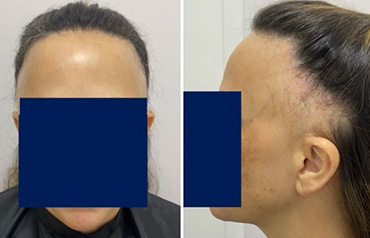
Introdução
A alopecia frontal fibrosante (AFF) compõe um grupo de desordens inflamatórias idiopáticas primárias que resultam em uma perda capilar permanente(1). A manifestação da doença se mostra angustiante para os pacientes e a condução terapêutica é desafiadora para os especialistas envolvidos(1).
Objetivo
O objetivo deste artigo, a propósito de um caso clínico, foi evidenciar o transplante capilar como alternativa terapêutica bem como aspectos relevantes que compõem a decisão pela cirurgia.
Discussão
Os primeiros relatos da AFF constam da década de 1990(2). À essa época, sua ocorrência era pouco frequente e limitada às mulheres no período do climatério(3). Não obstante, a epidemiologia desta doença vem sendo alterada com acréscimo significativo do número de casos, acometimento de pacientes mais jovens e do gênero masculino. Além de uma possível predisposição genética e influência hormonal, ainda pendentes de elucidação, tem-se considerado a relação de fatores etiológicos ambientais como desencadeantes da AFF e, especialmente, neste aumento de novos casos.
O processo destrutivo é irreversível; ocorre a partir de um infiltrado linfocitário seguido de dano às células pluripotentes presentes nos bulbos foliculares, ciclo capilar incompleto, inflamação folicular crônica e substituição por tecido cicatricial(1).
A manifestação clínica predominante é a perda e consequente recuo de toda extensão da linha capilar anterior, desde as costeletas, região frontal e temporais, bilateralmente, além das sobrancelhas(3,4). Apresentações em áreas como a região retroauricular e alterações cutâneas também podem ser observadas, em menor frequência.
A evolução lenta, por vezes, notada tardiamente ou mesmo diagnósticos equivocados, pode culminar em prejuízos estéticos e psicológicos relevantes quando do início do tratamento.
O diagnóstico é, fundamentalmente, estabelecido pela avaliação física , dermatoscopia e pode ser confirmado por biópsia.
Os tratamentos clínicos disponíveis, dentre os quais inibidores de 5a redutase (finasterida; dutasterida), medicações com ação anti-inflamatório (hidroxicloroquina; doxiciclina; corticoides), isotretinoína, imunomoduladores (pimecrolimus; tacrolimus), minoxidil, se limitam à tentativa de reduzir a progressão da doença.
Neste contexto, o transplante capilar aparece como uma possibilidade de restauração das regiões acometidas e consequente atenuação dos danos associados. Ocorre que a indicação cirúrgica é controversa(5,6). Artigos versando sobre indicação do transplante em casos de AFF, bem como uma avaliação dos resultados com um seguimento prolongado, são escassos(2,5).
Estudo analítico, descritivo, multicêntrico, retrospectivo, realizado por Vaño-Galván S, et al. confirma esta escassez. Nesta revisão foram incluídos um total de 51 pacientes, com uma média de idade de 54 anos. O transplante capilar foi realizado após um tempo médio de estabilização da doença de 15 meses. Esta estabilização foi avaliada clinicamente (ausência de progressão da alopécia na linha capilar fronto-temporal, após 12 meses) e por tricoscopia. A técnica folicullar unit transplantation (FUT) foi realizada em 44 pacientes e a técnica follicular unit extraction (FUE) foi realizada em 7 pacientes. O número médio de unidades foliculares transplantadas por procedimento foi de 1345. A localização mais frequente do transplante foi a área temporal (30 pacientes), seguida pela área frontal (22 pacientes) e as sobrancelhas (15 pacientes). Os pacientes foram acompanhados por uma média de 3,2 anos, no pós-operatório. Todos os pacientes receberam terapia medicamentosa para AFF, após o transplante. As taxas médias de sobrevida dos enxertos foram: 1 ano = 87%; 2 anos = 71%; 3 anos = 60%; 5 anos = 41%. Todos os 12 pacientes com um tempo de acompanhamento de pelo menos 5 anos após o procedimento cirúrgico apresentaram uma taxa de sobrevida dos enxertos inferior a 60%. Não houve diferenças na sobrevida por localização ou por terapia médica pós cirúrgica. Um maior tempo entre a estabilização da AFF e o transplante não foi associado a uma maior sobrevida dos enxertos. Dos 51 pacientes, 42 (82%) estavam satisfeitos(2).
Caso clínico
Paciente 47 anos, gênero feminino, branca, cabelos lisos e finos. Se mostrou lúcida, bastante esclarecida, apresentando queixa principal de importante perda capilar (foto 1). Relatou quadro depressivo e, com ênfase, outras repercussões negativas associadas ao quadro de alopecia. Sem demais história patológica pregressa digna de nota.
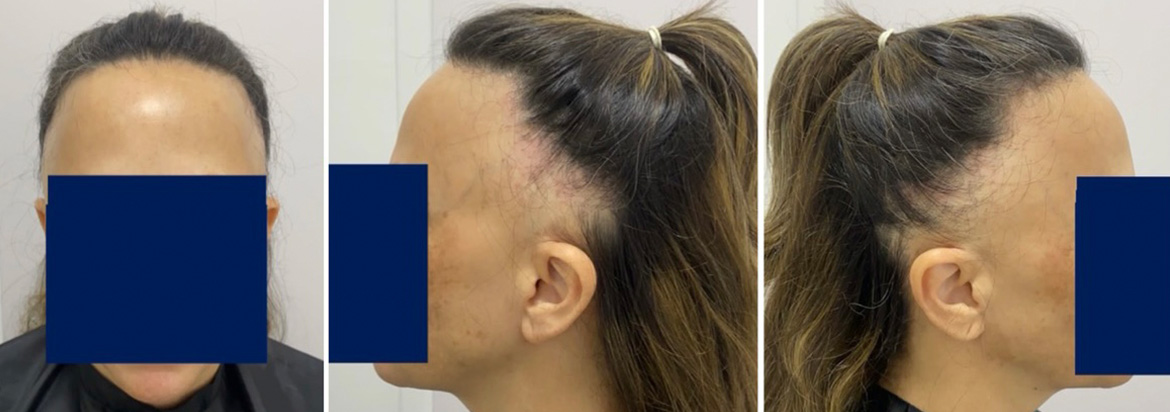
Foto 1 - Pré-operatório imediato
O acompanhamento dermatológico foi realizado por três especialistas, em momentos distintos, ao longo de aproximadamente três anos e meio entre o diagnóstico e a realização do transplante capilar.
Neste período, foi submetida a tratamento via oral com dutasterida, isotretinoína, colecalciferol, associado ao uso tópico de tacrolimus e minoxidil.
A biópsia, cuja hipótese diagnóstica inicial foi lúpus eritematoso sistêmico, resultou no seguinte laudo histopatológico, em suma:
- infiltrado inflamatório constituído por linfócitos, basicamente
- comprometimento inflamatório predominantemente perivascular
- acometimento da derme superficial e intermediária
- congestão e edema
- espessamento fibroso discreto do conjuntivo
Após reavaliação dos cortes histológicos anteriores e com novos cortes, conclui-se que o quadro histopatológico é compatível com alopecia frontal fibrosante.
O tempo entre a primeira consulta, com vistas a avaliar a possibilidade do transplante capilar, e a cirurgia foi de cinco meses.
Neste primeiro atendimento foi realizada avaliação pré-operatória habitual (anamnese e exame físico) acrescida da confirmação das informações fornecidas através das prescrições e laudos, bem como a confirmação do tempo de inatividade da doença (cerca de dois anos) junto a uma das dermatologistas que a assistiu.
Houve empenho em fornecer o máximo de informações e esgotar os esclarecimentos quanto à real possibilidade de insucesso precoce. Igualmente, foi alertada quanto à previsão de perda parcial ou total ao longo do tempo, mesmo havendo sucesso inicial.
A paciente foi informada sobre o fato de estudos disponíveis demonstrarem predominância de satisfação com os resultados obtidos a despeito da perda parcial observada ao longo de cinco anos(2), por exemplo. Todavia, foi ratificado que estes dados são baseados nos poucos estudos existentes sobre este tema.
O transplante foi realizado utilizando a técnica FUE, punchs 0,8 mm, pré-incisões com lâmina de safira de 1 mm, sendo a duração aproximada do procedimento de 10 horas.
Foram utilizados folículos doadores da região parieto occipital para pequena restauração frontal, restauração das costeletas e ampla restauração das regiões temporais.
- unidades foliculares 1 fio = 883 ----------- fios = 883
- unidades foliculares 2 fios = 1.304 -------- fios = 2.608
- unidades foliculares 3 fios = 820 ---------- fios= 2.610
- unidades foliculares total = 3.007 --------- fios total =6.101
A definição das linhas anteriores, portanto, à extensão das áreas a serem transplantadas foram estabelecidas almejando equilibrar a disponibilidade de unidades doadoras com uma densidade satisfatória na área receptora e o padrão feminino de implantação capilar (foto 2; foto 3).
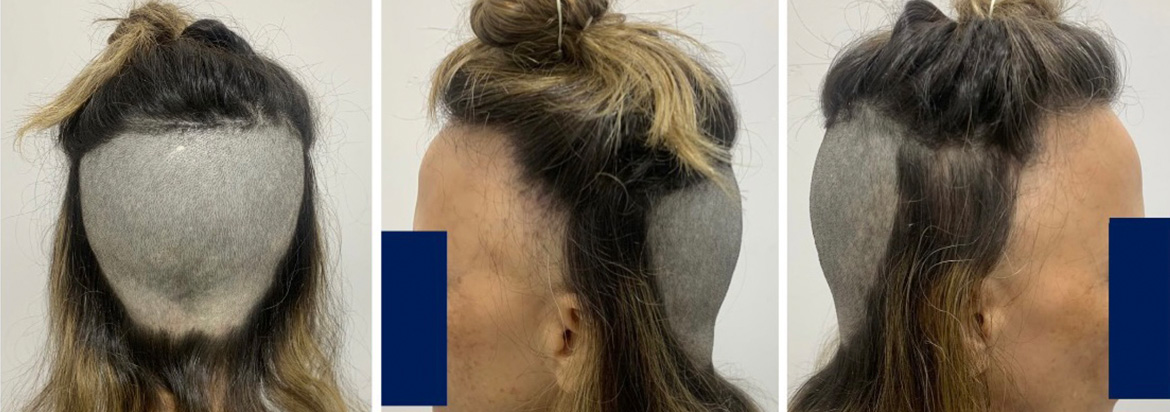 Foto 2 - Áreas doadoras
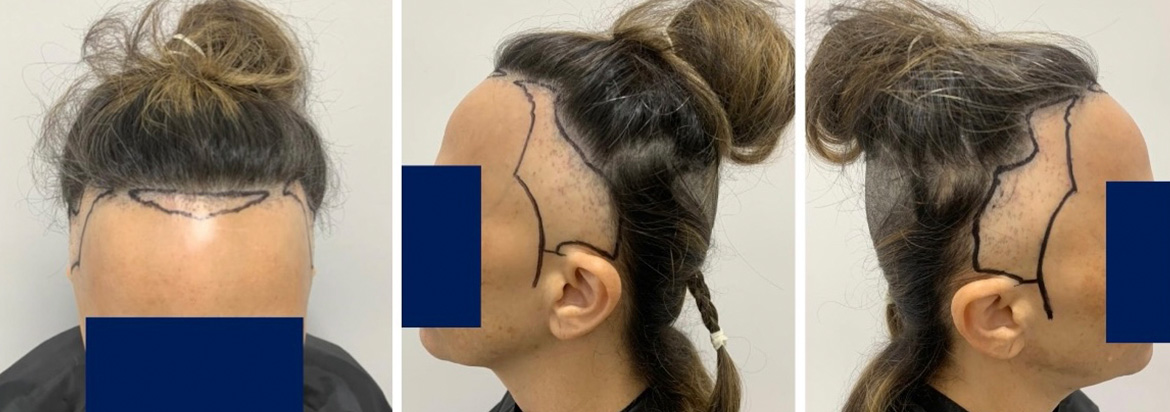
Foto 3 - Definição das áreas receptoras
A evolução pós-operatória foi observada até o 6o mês, quando da confecção deste texto. Até este momento, pode ser considerada habitual e esteve associada a alto grau de satisfação manifestado pela paciente. O uso de dutasterida, pimecrolimus e minoxidil tópico tem sido mantido (foto 4).
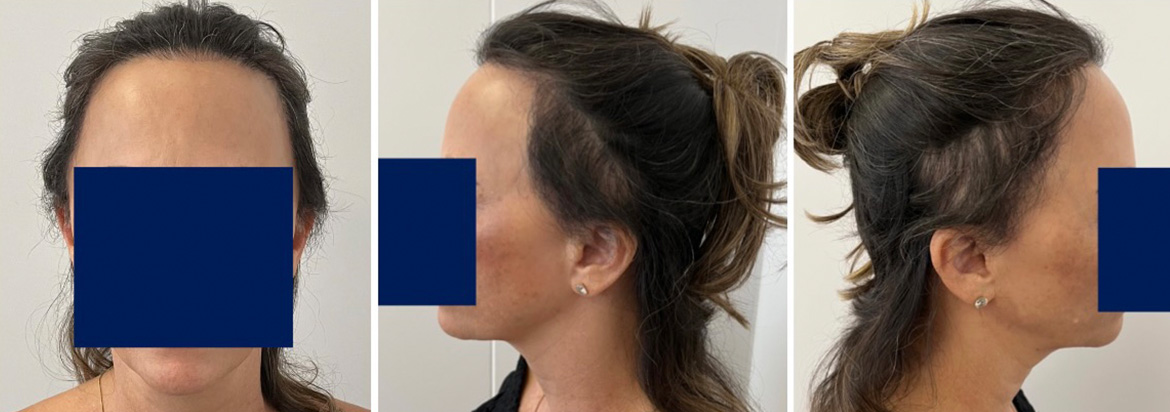
Foto 4 - Aspecto 6º mês pós-operatório
Conclusão
É evidente o benefício do diagnóstico e tratamento precoce da AFF objetivando minimizar danos físicos e psicológicos, haja vista o caráter irreversível da doença.
Em casos nos quais a perda capilar já implica em repercussões desfavoráveis, o transplante pode ser considerado. Todavia, a definição pela cirurgia deve ser precedida de uma avaliação bastante individualizada, sendo mandatório esgotar esclarecimentos quanto às chances de insucesso ou quanto à provável permanência temporária dos folículos transplantados, a despeito da satisfação descrita na limitada bibliografia disponível sobre este tema.
A divulgação das experiências e dos resultados obtidos na condução da AFF deve ser fomentada com vistas a ampliar conhecimento sobre esta doença e elucidar aspectos ora indefinidos.
REFERÊNCIAS
1- Fitzpatrick’s. Dermatology in General Medicine. 8th edition. 2012;995-998
2- Vaño-Galván S, et al., Hair Transplant in Frontal Fibrosing Alopecia: A multicenter review of 51 patients. J Am Acad Dermatol. 2019 research letter
3- Kossard S, Lee MS, Wilkinson B. Postmenopausal frontal fibrosing alopecia: a frontal variant of lichen planopilaris. J Am Acad Dermatol. 1997;36:59-66
4- Vaño-Galván S, et al., Frontal Fibrosing Alopecia: A multicenter review of 355 patients. J Am Acad Dermatol.2014;70(4);670-678
5- Nusbaum BP, Nusbaum AG. Frontal Fibrosing Alopecia in a man: results of follicular unit test grafting. Dermatol Surg. 2010;36(6):959-962
6- Jiménez F, Poblet E. Is Hair Transplantation Indicated at in Frontal Fibrosing Alopecia? Dermatol Surg. 2013;39(7):1115-1118
Folículo - Edição 24
English version
Hair transplantation in frontal fibrosing alopecia: Clinical Case Review
Introduction
Frontal fibrosis alopecia (FFA) comprises a group of primary idiopathic inflammatory disorders resulting in permanent capillary loss(1).
The disease recurrence is distressing for patients and therapeutic management is challenging for the specialists involved(1).
Goal
Regarding a clinical case, this article highlights hair transplantation as a therapeutic alternative as well as relevant aspects that make up the decision for surgery.
Discussion
The first reports of the FFA date from the 1990s(2). At that time, its occurrence was infrequent and limited to women during the climacteric period(3). Nevertheless, the epidemiology of this disease has been changing with a significant increase in the number of cases, affecting younger and male patients. Additionally, to a possible genetic predisposition and hormonal influence, which is still pending elucidation, environmental etiological factors has been considered as triggering of FFA and, especially, in these increasing new cases.
The destructive process is irreversible; it occurs from a lymphocytic infiltrate followed by damage to pluripotent cells found in the follicular bulbs, incomplete capillary cycle, chronic follicular inflammation and replacement by scar tissue(1).
The predominant clinical manifestation is loss and consequent retreat of the entire length of the anterior hairline, from the sideburns, frontal and temporal regions in addition to the eyebrows(3,4). It also can be found in areas such as the retroauricular region and skin changes, to a lesser extent.
The slow evolution, sometimes noticed late or even misdiagnoses, can lead to relevant aesthetic and psychological damages in the beginning of the treatment.
The diagnosis is fundamentally established by physical evaluation, dermoscopy and can be confirmed by biopsy.
The available clinical treatments, including 5a reductase inhibitors (finasteride; dutasteride), medications with anti-inflammatory (hydroxychloroquine; doxycycline; corticosteroids), isotretinoin, immunomodulators (pimecrolimus; tacrolimus), minoxidil, are limited to an attempt to reduce the progression of the disease.
Hair transplantation appears as a possibility of restoring the affected regions and mitigation of associated damage. The surgical indication is controversial(5,6). Articles on the indication of transplantation in cases of FFA, as well as an evaluation of the results with a prolonged follow-up, are scarce(2,5).
An analytical, descriptive, multicenter, retrospective study carried out by Vaño-Galván S, et al. confirms this shortage. A total of 51 patients (mean age of 54 years) were included in this review. Hair transplantation was performed after an average disease stabilization time of 15 months. This stabilization was evaluated clinically (no progression of alopecia in the frontal and temporal hairline after 12 months) and by trichoscopy. The follicular unit transplantation (FUT) technique was performed in 44 patients and the follicular unit extraction (FUE) technique was performed in 7 patients. The average number of follicular units transplanted per procedure was 1345. The most frequent location of the transplant was the temporal area (30 patients), followed by the frontal area (22 patients) and the eyebrows (15 patients). Patients were followed up for an average of 3.2 years postoperatively. All patients received drug therapy for FFA after transplantation. The median graft survival rates were: 1 year = 87%; 2 years = 71%; 3 years = 60%; 5 years = 41%. All 12 patients with at least 5-year follow-up after the surgical procedure had a graft survival rate of less than 60%. There were no differences in survival by location or by post-surgical medical therapy. A longer time between FFA stabilization and transplantation was not associated with longer graft survival. Of the 51 patients, 42 (82%) were satisfied(2).
Clinical case
Patient: 47 years old, female, white, straight and fine hair. She was lucid, quite enlightened, presenting a main complaint of significant hair loss. (photo 1). She reported a depressive condition and emphasized other negative repercussions associated with the condition of alopecia. No other past pathological history worth noting.
Immediate preoperative
Three specialists performed the dermatology follow-up, at various times, over approximately three and a half years between diagnosis and hair transplantation.
During this period, she underwent the oral treatment with dutasteride, isotretinoin, cholecalciferol, associated with topical use of tacrolimus and minoxidil.
The biopsy, whose initial diagnostic hypothesis was systemic erythematosus lupus, resulted in the following report histopathological, in short:
- inflammatory infiltrate consisting of lymphocytes, basically
- perivascular inflammatory involvement
- involvement of the superficial and intermediary dermis
- congestion and edema
- mild fibrous thickening of the connective tissue
After reassessment of previous histological sections and with new cuts, concluded that the histopathological picture is compatible with fibrosing frontal alopecia.
The interval between the first visit to evaluate the possibility of hair transplantation, and the surgery was five months.
In this first visit, a previous assessment for the surgery was carried out(anamnesis and physical examination) plus confirmation of the information provided through the prescriptions and reports, as well as confirmation of the time of inactivity of the disease (about two years) with one of the dermatologists.
There was an effort to provide as much information as possible and exhaust the clarifications regarding real possibility of initial failure. Likewise, it was warned about the forecast of partial or total loss over time, even with initial success.
The patient was informed that available studies demonstrate a predominance of satisfaction with the results obtained in spite of the partial loss observed over five years(2), for example. These data are based on the few existing studies on this topic.
Transplantation was performed using the FUE technique, 0.8 mm punches, 1-mm sapphire blade pre-incisions, the procedure took approximately 10 hours.
Donor follicles from the parietal occipital region were used for small frontal restoration, restoration of sideburns and extensive restoration of temporal regions.
- follicular units 1 hair = 883 ———————- hairs = 883
- follicular units 2 hairs = 1,304 ———————- hairs = 2,608
- follicular units 3 hairs = 820 ———————- hairs = 2,610
- total follicular units = 3,007 ———————- hairs total = 6,101
Therefore, the definition of the previous lines to the extension of the areas to be transplanted were established aiming to balance the availability of donor units with a satisfactory density in the recipient area and the female pattern of hair implantation. (photo 2; photo 3).
Donor areas
Definition of receiving areas
The postoperative evolution was observed until the 6th month when this text was written. Until now, it can be considered habitual, and the patient showed a high satisfaction. The use of dutasteride, pimecrolimus and topical minoxidil has been maintained (photo 4).
Aspect in the 6th postoperative month
Conclusion
It is evident the benefit of the diagnosis and initial treatment of FFA to minimize physical and psychological damage, given the irreversible nature of the disease.
In cases where hair loss already implies unfavorable repercussions, transplantation can be considered. However, the definition of surgery must be preceded by a very individualized assessment, and it is mandatory to provide clarifications regarding the chances of failure or the probable temporary permanence of the transplanted follicles, despite the satisfaction described in the limited bibliography available on this topic.
The dissemination of experiences and results obtained in the conduction of FFA should be encouraged with a view to expanding knowledge about this disease and elucidating undefined aspects.
REFERENCES
1- Fitzpatrick’s. Dermatology in General Medicine. 8th edition. 2012;995-998
2- Vaño-Galván S, et al., Hair Transplant in Frontal Fibrosing Alopecia: A multicenter review of 51 patients. J Am Acad Dermatol. 2019 research letter
3- Kossard S, Lee MS, Wilkinson B. Postmenopausal frontal fibrosing alopecia: a frontal variant of lichen planopilaris. J Am Acad Dermatol. 1997;36:59-66
4- Vaño-Galván S, et al., Frontal Fibrosing Alopecia: A multicenter review of 355 patients. J Am Acad Dermatol.2014;70(4);670-678
5- Nusbaum BP, Nusbaum AG. Frontal Fibrosing Alopecia in a man: results of follicular unit test grafting. Dermatol Surg. 2010;36(6):959-962
6- Jiménez F, Poblet E. Is Hair Transplantation Indicated at in Frontal Fibrosing Alopecia? Dermatol Surg. 2013;39(7):1115-1118

