
Dr. Henrique Radwanski
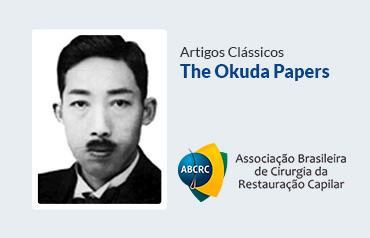
Há 20 anos, na edição de janeiro 2004 da revista FORUM, foi publicado um artigo de grande relevância para a história da restauração capilar. De autoria de Richard Shiell, um dos fundadores da ISHRS, The Okuda Papers é o resultado de uma verdadeira operação de investigação que percorre mais de 60 anos através de dois continentes. Este artigo coloca o nome de Shojui Okuda no topo do pódio do pioneirismo no transplante de cabelo.
Quase nada se sabe deste médico japonês. Por duas razões, seus extensos trabalhos de pesquisa sobre o cabelo não tiveram nenhuma repercussão na literatura mundial. Em primeiro lugar, seus experimentos e estudos clínicos, repletos de informações detalhadas, foram escritos em velho kanji, uma forma antiga pictográfica de japonês, de difícil interpretação. Com mais de 50 páginas originais, quando o trabalho foi finalmente traduzido para o inglês, chegava a mais de 200 páginas. Em 2º. lugar, sua data de publicação, no Japão, foi extremamente infeliz. Foi aceito pela Japanese Journal of Dermatology and Urology em 1939, véspera da 2ª Guerra Mundial.
Dr. Shiell soube destes estudos pioneiros quando viajava pelo Japão em 2003. Lá conheceu os escritos do Dr. Okuda pelo colega Kenichiro Imagawa. Entretanto, tampouco ele conseguia ler o original, e foi ajudado pelo seu pai, Dr. Yoshiro Imagawa, que então passou o manuscrito do velho kanji para um inglês impecável. E foi assim que o mundo reconheceu, finalmente, Dr. Okuda como o pioneiro da cirurgia capilar. Alguns anos mais tarde (1959) Dr. Norman Orentreich de Nova Iorque, publicaria seus trabalhos clínicos, utilizando muitas das ideias e instrumentos do seu antepassado japonês. Não há, entretanto, nenhum registro de que Orentreich tivesse conhecimento do que havia sido escrito; então, trata-se aparentemente de uma afortunada sincronia.
The Okuda Papers consistiam em cinco seções, e seu conjunto foi publicado na revista asiática com o título Clinical and Experimental Study of Living Hair Transplantation. As seções descreviam: 1]. Experimentos clínicos no cabelo vivo 2]. Estudos histológicos após transplante 3]. Estudos experimentais com homoenxertos e heteroenxertos em animais 4]. Resultados histológicos em animais 5]. Pesquisa de alterações nervosas pós-transplante de cabelo. Na 1ª. parte, o autor dá crédito a vários precursores que pesquisavam transplante de cabelo e que foram esquecidos: Schweininger (1875), Tieffenbach (1882), Thiersh, Eisenberg, Krause (1896), Reverdin, Devis, Takahashi entre outros. Okuda descreve o uso de uma “serra arredondada” que nada mais é do que um punch afiado. Utilizava de diferentes diâmetros: 1 – 4 mm, observando que quanto menor, maior o risco às raízes do cabelo. Notou que, invariavelmente, enxertos entre seres diferentes eram sempre rejeitados num período de até três semanas, deixando uma área cruenta. Ele também descreveu o que fundamenta a cirurgia de restauração capilar: os folículos são área-doadora dominantes. Ao fazer transplante, em vacas, de pelos brancos sobre área de pelos pretos, o fio transplantado não mudava de cor.
Por infeliz circunstância, os trabalhos minuciosos e detalhados do Dr. Okuda não foram reconhecidos em vida. No Congresso da ISHRS em Chicago, 2015, do qual participei, houve uma cerimônia muito simbólica em homenagem ao Dr. Okuda. Com a presença de seu neto, Dr. Takahiko Okuda, nosso estimado colega Dr. Paco Jimenez fez uma bela apresentação dos trabalhos deste verdadeiro pioneiro, prestando um devido tributo aos The Okuda Papers. Ao final, o auditório inteiro levantou-se para um longo aplauso.
English version
The Okuda Papers
Dr. Henrique Radwanski
Twenty years ago, in the January 2004 issue of FORUM magazine, an article of great relevance to the history of hair restoration was published. Written by Richard Shiell, one of the founders of the ISHRS, The Okuda Papers is the result of a real research operation spanning more than 60 years across two continents. This article places Shojui Okuda's name at the top of the pioneering hair transplant podium.
Almost nothing is known about this Japanese doctor. For two reasons, his extensive research on hair had no repercussions in world literature. First, his clinical experiments and studies, full of detailed information, were written in old kanji, an old pictographic form of Japanese, difficult to interpret. With more than 50 original pages, when the work was finally translated into English, it reached more than 200 pages. Second, its publication date in Japan was extremely unfortunate. It was accepted by the Japanese Journal of Dermatology and Urology in 1939, on the eve of World War II.
Dr. Shiell learned of these pioneering studies while traveling in Japan in 2003. There he discovered the writings of Dr. Okuda by colleague Kenichiro Imagawa. However, he could not read the original either, and was helped by his father, Dr. Yoshiro Imagawa, who then passed on the manuscript of the old kanji to impeccable English. And that was how the world finally recognized Dr. Okuda as the pioneer of hair surgery. A few years later (1959) Dr. Norman Orentreich from New York would publish his clinical work, using many of the ideas and tools of his Japanese ancestor. There is, however, no record that Orentreich was aware of what had been written; So, it is apparently a fortunate synchrony.
The Okuda Papers consisted of five sections, and their set was published in the Asian journal under the title Clinical and Experimental Study of LivingHair Transplantation. The sections described: 1]. Clinical experiments on living hair 2]. Histological studies after transplantation 3]. Experimental studies with homografts and heterografts in animals 4]. Histological results in animals 5]. Research of nerve changes after hair transplantation. In the first part, the author gives credit to several precursors who researched hair transplantation and who have been forgotten: Schweininger (1875), Tieffenbach (1882), Thiersh, Eisenberg, Krause (1896), Reverdin, Devis, Takahashi and others. Okuda describes the use of a “rounded saw” that is nothing more than a sharp punch. He used different diameters: 1 - 4 mm, noting that the smaller the diameter, the greater the risk to the hair roots. He noted that, invariably, grafts between different beings were always rejected within a period of up to three weeks, leaving a bloody area. He also described what underlies hair restoration surgery: follicles are the dominant donor area. When white hair was transplanted onto black hair in cows, the transplanted hair did not change colour.
By an unfortunate circumstance, the meticulous and detailed work of Dr. Okuda was not recognised when he was alive. At the ISHRS Congress in Chicago, 2015, in which I attended, there was a very symbolic ceremony in honour of Dr. Okuda. With the presence of his grandson, Dr. Takahiko Okuda, our esteemed colleague Dr. Paco Jimenez gave a fine presentation of the work of this true pioneer, paying due tribute to The Okuda Papers. At the end, the entire auditorium rose to a long applause.

