
Dr. Leopoldo Duailibe
Uma análise clínica
O texto abaixo abordará os principais aspectos da tricologia clínica em relação às possíveis patologias que podem acometer as sobrancelhas. Já deixando claro ao leitor que não será abordado sobre a técnica desse tipo de cirurgia.
O transplante de sobrancelhas é um procedimento que vem crescendo ao longo dos últimos anos e que, por diversos motivos como expansão da área de atuação, busca por novos nichos ou mesmo por demanda espontânea dos pacientes, vem gerando muita curiosidade nos colegas mundo afora.
No entanto, antes de nos aventurarmos nesse tipo de cirurgia é extremamente importante que saibamos não somente a técnica, mas também excluir possíveis doenças que podem ter levado à rarefação das sobrancelhas. E que se não diagnosticadas previamente, pode levar a resultados insatisfatórios no pós-cirúrgico.
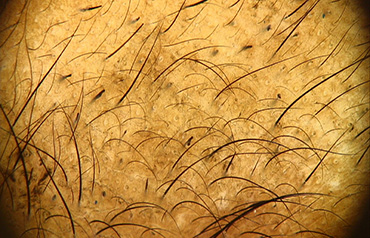
Como sempre, o contexto global, examinando o paciente por completo ajuda e muito em buscarmos o diagnóstico mais adequado. Por exemplo, uma senhora de 60 anos com recuo da linha de implante capilar e rarefação de sobrancelhas que não apresentou repilação espontânea ao longo dos anos, muito provavelmente tem alopecia frontal fibrosante e não alopecia areata. Esse caso clássico de AFF parece simples, como a grande maioria, mas casos iniciais podem ser uma armadilha e a tricoscopia das sobrancelhas é uma ferramenta fundamental para nos auxiliar.
Alopecia Frontal Fibrosante (AFF)
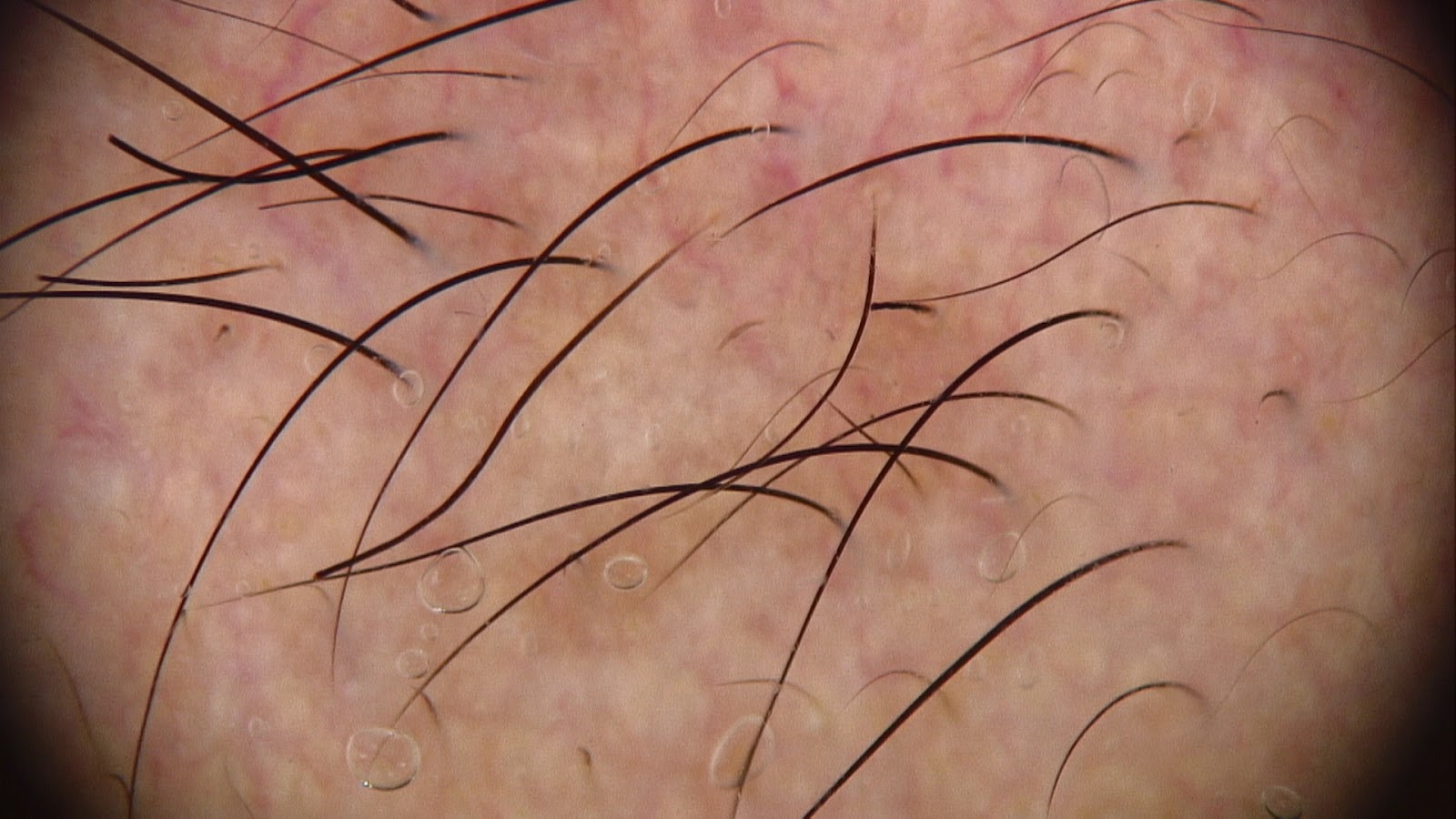
Em pacientes com alopecia frontal fibrosante mais de 50% dos casos começam com acometimento das sobrancelhas e somente depois que irá iniciar a rarefação do couro cabeludo. Portanto, nos casos mais iniciais o diagnóstico pode ser mais difícil. A tricoscopia das sobrancelhas pode apresentar sinais sugestivos de atividade da doença como pontos pretos e fios distróficos, além da rarefação capilar.
Alopecia Frontal Fibrosante – tricoscopia das sobrancelhas: rarefação capilar difusa, pontos pretos e fios distróficos
Observem na figura que esses sinais se apresentam de forma difusa. Esse é um ponto importante quando queremos diferenciar de sobrancelhas que foram “feitas” em salão de beleza. Nesses casos, podem existir pontos pretos pelo arrancamento dos fios, porém se dispõe mais na periferia da sobrancelha do que difusamente e a rarefação tende a ser menos pronunciada.
Curiosamente, raramente encontramos a descamação perifolicular classicamente descrita no couro cabeludo. Por isso, a ausência desse achado tão comum em outras áreas, não deve eliminar a suspeita de AFF.
A epidemiologia nesses casos também é extremamente relevante. Sempre considerar que a AFF é mais frequente em mulheres, caucasianas e que estejam no período perimenopausa.
Tração/Tricotilomina (TTM)
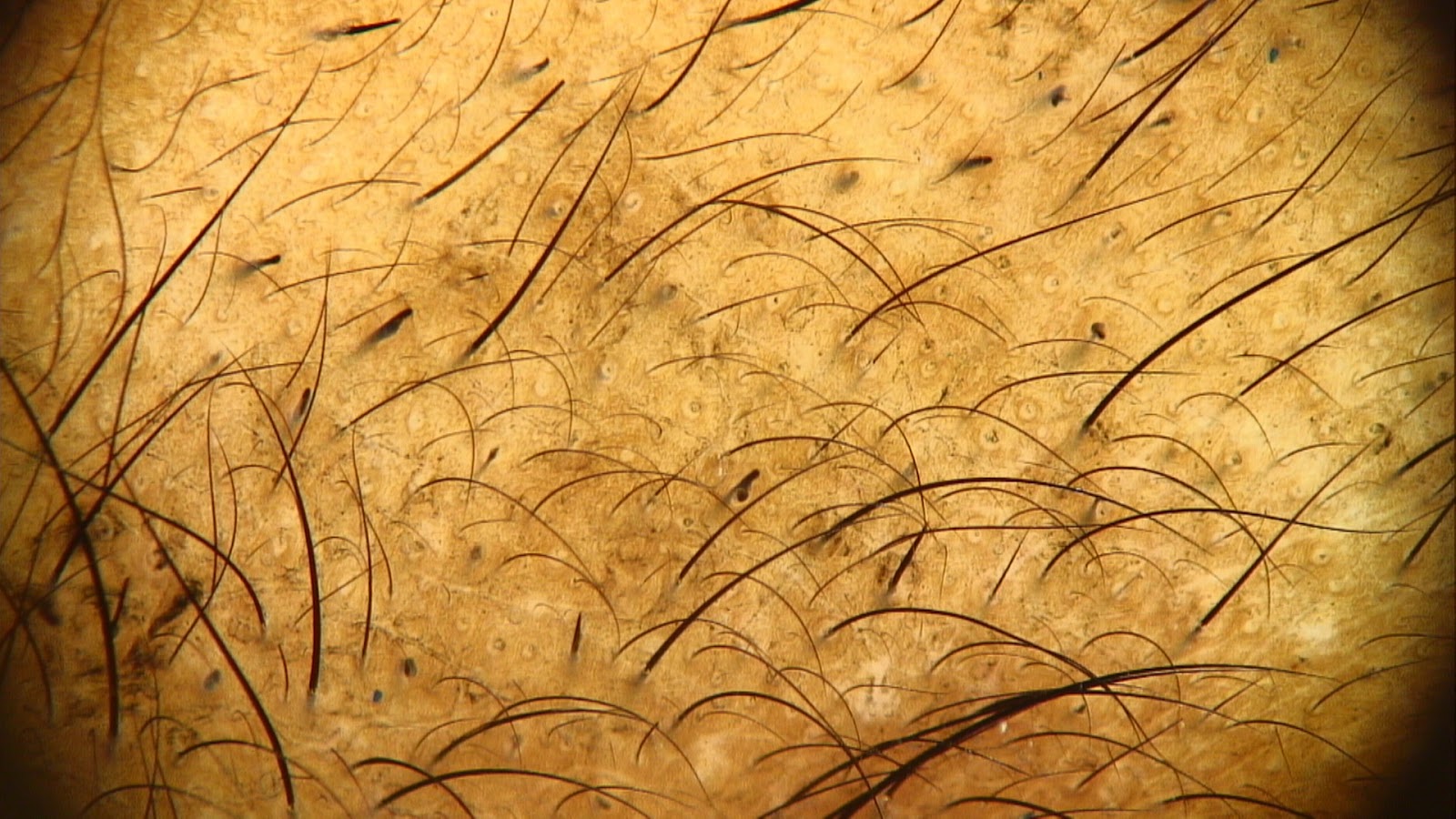
Já comentamos brevemente sobre um dos tipos de tração acima. Aqueles causadas por mulheres que “fazem” a sobrancelhas no salão. Nesses casos, os sinais descritos são restritos à periferia das sobrancelhas e, em geral, não há outra causa de queda de cabelo correlacionada. Mais comumente em jovens podemos observar rarefação difusa das sobrancelhas, podendo estar associado ou não ao acometimento conjunto do couro cabeludo. Na tricoscopia, sempre fundamental, podemos observar os mesmos sinais de pontos pretos e fios distróficos. Mas, além disso, muitos fios quebrados/fraturados, aspecto em vassoura e caracteristicamente apresentando diversos comprimentos Esse aspecto caótico na tricoscopia tem que ser associado com tricotilomania. Tricotilomania – tricoscopia: aspecto caótico com fios fraturados em diversos comprimentos
O ato compulsivo de arrancar os fios com os dedos leva a fratura dos fios em diferentes pontos das hastes de cabelo, levando aos diversos sinais tricoscópicos e aspecto caótico. Apesar de a maioria desses pacientes com TTM serem jovens, adolescentes ou mesmo crianças sendo menos provável uma possível indicação cirúrgica, vale a lembrança desses casos, pois podem surgir no consultório. Alopecia areata (AA) Essa doença talvez seja o maior fator que cause confusão com a alopecia frontal fibrosante e que a clínica e a epidemiologia serão muito importantes para diferenciá-las.
Em pacientes com AA acometendo sobrancelhas os sinais tricoscópicos são muito semelhantes aos da AFF, como os pontos pretos e fios distróficos A rarefação é mais localizada, ou seja, uma parte da sobrancelha apresenta acometimento mais proeminente. Porém, também pode ocorrer rarefação difusa. Muitos casos vão se apresentar unilateralmente, o que também ajuda a diferenciar de AFF, pois nessa é bilateral.
Em relação à epidemiologia, o primeiro episódio de AA ocorre mais comumente em crianças ou adultos jovens, e mais raramente em adultos/idosos. Esse é outro importante dado, pois em AFF ocorre em idade mais avançada.
Em casos suspeitos das duas doenças, por exemplo, uma mulher branca com rarefação bilateral recente e sem acometimento de couro cabeludo, o mais indicado seria fazer uma biópsia de sobrancelha para diferenciar AA e AFF, pois nesses casos a tricoscopia é limitada. Uma alternativa é acompanhar com imagens seriada a cada 3 meses a evolução das sobrancelhas e do couro cabeludo. Constitucional Essas pacientes não apresentam rarefação difusa e homogênea das sobrancelhas com afinamento dos fios sem sinais tricoscópicos como eritema, descamação perifolicular, fios dristróficos ou pontos pretos.
Na Figura 3, observe um esquema de diferenciação dos vários tipos de patologias acometendo as sobrancelhas.
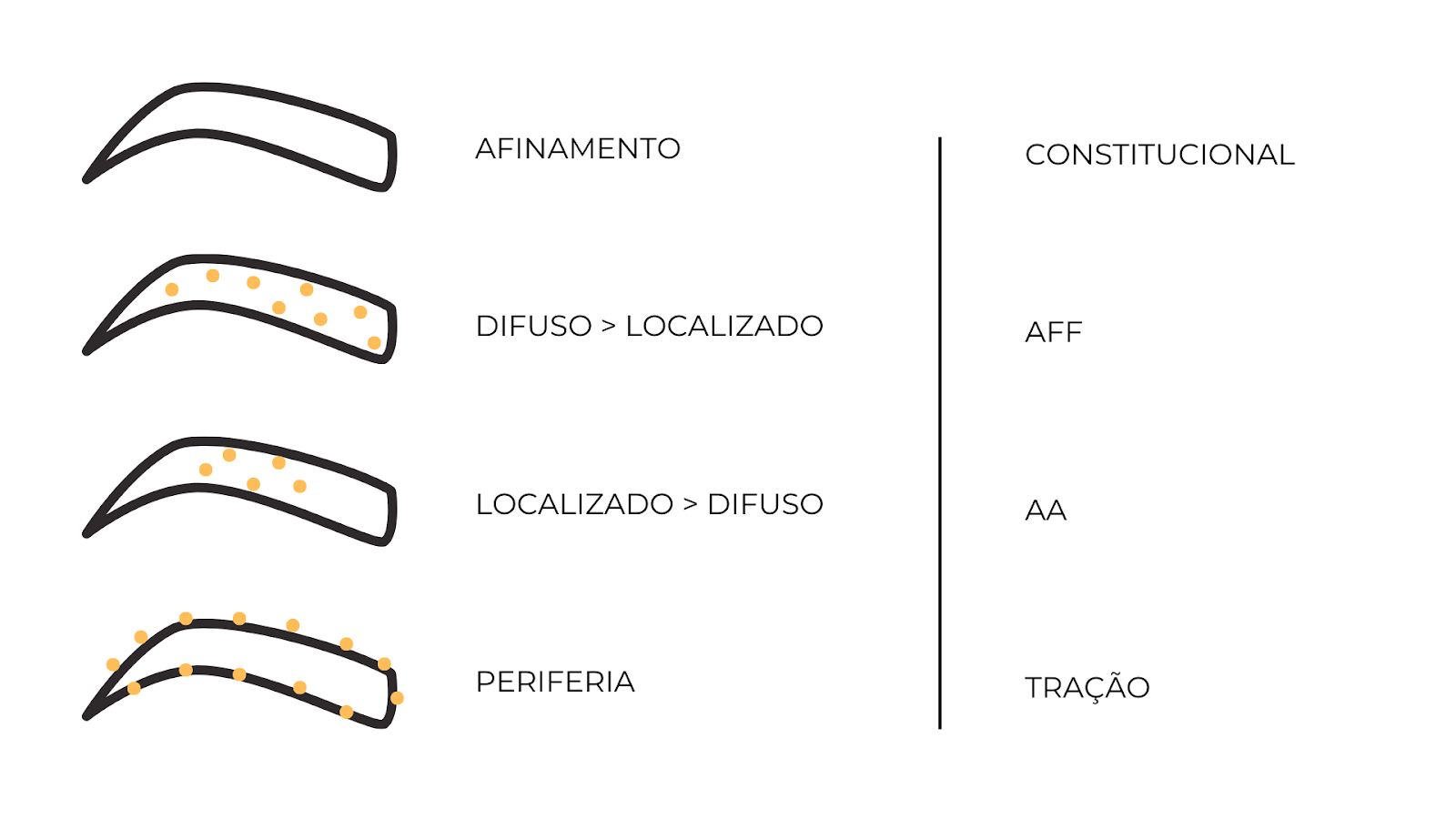
Padrão mais comum de acometimento nos diferentes tipos de patologias
Edição 26, artigo 8.
English version
Eyebrow thinning: can I have a transplant?
Dr. Leopoldo Duailibe
A clinical analysis
The text below will cover the main aspects of clinical trichology in relation to the possible pathologies that can affect the eyebrows. We emphasize to our readers that the technique of this type of surgery will not be discussed.
Eyebrow transplant is a procedure that has been growing over the past few years, for several reasons, such as expansion of the area of practice, search for new niches, or even spontaneous demand from patients. This procedure has been generating a lot of curiosity among colleagues worldwide.
However, before going into this type of surgery, it is extremely important that we know not only the technique, but also to rule out possible diseases that may have led to the thinning of the eyebrows. And, if not diagnosed beforehand, it can lead to unsatisfactory results in the post-surgery period.
As always, examining the patient as a whole helps a lot in finding the most appropriate diagnosis. For example, a 60-year-old lady with retreating hairline and thinning eyebrows that has not spontaneously receded over the years, most likely has frontal fibrosing alopecia and not alopecia areata. This classic case of AFF seems simple, as do the majority, but early cases can be a trap and eyebrow trichoscopy is a key tool to help us.
Frontal Fibrosing Alopecia (FFA)
In patients with frontal fibrosing alopecia, more than 50% of the cases start with involvement of the eyebrows, and only later scalp thinning begins. Therefore, in the earlier cases the diagnosis can be more difficult.
Trichoscopy of the eyebrows may show signs suggesting disease activity such as black dots and dystrophic hairs, in addition to hair thinning.
Frontal Fibrosing Alopecia – eyebrow trichoscopy: Diffuse capillary thinning, black dots, and dystrophic hairs
In the figure, these signs are presented in a diffuse form. This is an important point when we want to differentiate from eyebrows that have been "done" in a beauty salon. In these cases, there may be black spots due to the plucking of the hairs, but they are arranged more at the edge of the eyebrow than diffusely and the thinning tends to be less marked.
Interestingly, we rarely find the perifollicular desquamation classically described on the scalp. Therefore, the absence of this finding, so common in other areas, should not eliminate the suspicion of FFA.
In these cases, epidemiology is also extremely relevant. Always consider that FFA is more frequent in Caucasian women, in the perimenopausal period.
Traction/Trichotillomania (TTM)
We have already briefly commented on one of the traction types mentioned above. Those caused by women who have their eyebrows “done” at the salon. In these cases, the signs described are restricted to the edge of the eyebrows and, in general, there is no other correlated cause of hair loss.
More commonly in young people we can observe diffuse thinning of the eyebrows, which may or may not be associated with the scalp.
In trichoscopy, which is always fundamental, we can observe the same signs of black dots and dystrophic hairs. In addition, there are many broken/fractured hairs, with a broom-like appearance, and characteristically presenting several lengths. This chaotic appearance on trichoscopy has to be associated with trichotillomania.
Trichotillomania - trichoscopy: chaotic appearance with broken hair in various lengths
The compulsive act of pulling out hair with the fingers leads to hairline fractures at different points on the hair stems, leading to diverse trichoscopic signs and chaotic appearance. Although most of these TTM patients are young, adolescents, or even children, and a possible surgical indication is less likely, it is worth remembering these cases, as they may arise in the medical office.
Alopecia areata (AA)
This disease is the biggest confusion factor with frontal fibrosing alopecia and that the clinic analysis and epidemiology will be very important in differentiating them.
In patients with AA affecting the eyebrows, the trichoscopic signs are very similar to those of FFA, such as black spots and dystrophic hairs. However, diffuse thinning can also occur. Many cases will be unilateral, which also helps differentiate it from FFA, since the latter is bilateral.
Regarding epidemiology, the first episode of AA occurs most commonly in children or young adults, and more rarely in adults/elderly people. This is another important fact, because, in FFA, it occurs at an older age.
In suspected cases of both diseases, for example, a white woman with recent bilateral thinning and no scalp involvement, the most indicated would be a brow biopsy to differentiate AA and FFA, because in these cases trichoscopy is limited. An alternative is to follow the evolution of the eyebrows and scalp with serial imaging every three months.
Constitution
These patients do not present diffuse and homogeneous thinning of the eyebrows with thinning of the hairs without trichoscopic signs such as erythema, perifollicular scaling, dristrophic hairs or black dots.
In Figure 3, we can observe a scheme of differentiation of the various types of pathologies affecting the eyebrows.
Most common pattern of involvement in the different types of pathologies
To finish this article, it is fundamental to use trichoscopy looking for the suggestive signs of diseases that can affect the eyebrows. When in doubt, do not hesitate to biopsy or follow up the patients before indicating surgery.
References
1 - Suchonwanit, P, Thammarucha, S. Eyebrow growth pattern analysis in patients with eyebrow hypotrichosis after receiving topical treatment: A retrospective study. J Cosmet Dermatol. 2020; 19: 1404– 1408
2 - Anzai A, Donati A, Valente NY, Romiti R, Tosti A. Isolated eyebrow loss in frontal fibrosing alopecia: relevance of early diagnosis and treatment. Br J Dermatol. 2016 Nov;175(5):1099-1101
Issue 26, article 8.

