
Descrição da técnica de cuidados perioperatório e relato de um caso modelo
Dr. Thiago Lins do Vale
Cirurgião plástico
Membro especialista SBCP, ABCRC e ASPS
Dra. Tainá Lima Reis Vilaça
Médica anestesiologista
Graduada pela Universidade Federal do Maranhão - UFMA
Residência Médica pela Universidade Estadual de Campinas - UNICAMP
Especialização em Anestesia Regional Guiada por Ultrassonografia pelo Hospital Sírio-Libanês
CUIDADO PERIOPERATÓRIO
O período perioperatório compreende o momento pré-operatório, o transoperatório e o pós-operatório, ou seja, desde o momento em que o paciente sabe de seu diagnóstico e decide pela cirurgia até sua recuperação e reabilitação.
A prática médica vem incorporando de maneira surpreendentemente rápida os novos conhecimentos relacionados à cirurgia e procedimentos cirúrgicos menores. Os recursos tecnológicos e o aprimoramento técnico das equipes aumentaram o grau de confiança de médicos e pacientes. Êxitos consecutivos, associados ao menor índice de complicações pós-operatórias, resultaram na ampliação da população cirúrgica.
No pré-operatório se faz necessária uma ótima avaliação do paciente tanto pelo médico cirurgião quanto pelo anestesiologista, a fim de identificar possíveis fatores que possam interferir na segurança e resultado da cirurgia e grau de satisfação do paciente. Nesse sentido, se dá a importância de uma avaliação pré-anestésica adequada e uma via de comunicação livre entre cirurgião e anestesiologista para melhor condução perioperatória do paciente.
Já no primeiro contato entre anestesiologista e paciente, é possível criar uma relação de confiança que se faz fundamental em todo o processo anestésico-cirúrgico. Nesse momento também se insere a importância da analgesia preemptiva.
CONCEITO DE ANALGESIA PREEMPTIVA
O controle da dor pós-operatória tem gerado muito interesse, especialmente nas últimas décadas, quando se verificou que a analgesia pós-operatória era feita de maneira inadequada, apesar dos avanços no entendimento da fisiologia da dor, do mecanismo de ação e do desenvolvimento de sistemas sofisticados de administração de medicamentos, constatando-se a necessidade de progresso nessa área (1-3).
Dentro desse contexto, algumas modalidades de tratamento têm sido discutidas, como a analgesia preemptiva. O termo “preemptiva” implica uma forma de analgesia que, iniciada antes do estímulo doloroso ser gerado, previne ou diminui a dor subseqüente. O conceito de analgesia preemptiva foi formulado inicialmente na primeira década do século XX, quando foi recomendada a associação de anestesia regional à geral para prevenir a dor causada por mudanças no sistema nervoso central durante o ato operatório, devido à não supressão da condução do estímulo doloroso para o encéfalo. Essa ideia foi reavivada por Woolf que, ao estudar animais submetidos a estímulos nociceptivos intensos, observou que eram geradas alterações sensoriais (dor contínua, aumento de sensibilidade dolorosa e dor em resposta a estímulos não dolorosos), posteriormente explicadas, não apenas por mudanças ocorridas através de mecanismos periféricos, mas também por mudanças (hiperexcitabilidade) na atividade da medula espinhal (4).
Em estudo experimental, Woolf e col. descreveram que, uma vez estabelecida a hiperexcitabilidade dos neurônios medulares, doses muito altas de morfina são necessárias para bloquear esse estado, ao passo que, com pequenas doses administradas antes que os estímulos cheguem ao sistema nervoso central, obtém-se supressão da excitabilidade. Essas informações mostraram que o tratamento pré-operatório da dor poderia prevenir um estado de hiperexcitabilidade da medula espinhal (5, 10).
A proposta da analgesia preemptiva é prevenir ou diminuir o desenvolvimento de qualquer “memória” que a dor causaria no sistema nervoso central, resultando como consequência menor necessidade de analgésico. A partir da definição de que analgesia preemptiva é uma intervenção pré-operatória que previne ou diminui a dor pós-operatória, a diferença entre os resultados de analgesia feita antes e após o início de uma operação evidenciaria um efeito preemptivo. Entretanto, a maior ênfase não deve ser dada apenas ao momento do início do tratamento, mas ao fenômeno fisiopatológico que deve ser prevenido: a alteração do processamento sensorial (11, 12).
Fica claro que resultados obtidos através de intervenções pré-operatórias ou pré-incisionais, que não sejam capazes de prevenir as alterações centrais, não devem ser considerados preemptivos, pois preemptivo não quer dizer apenas “anterior”.
PAPEL DA PREGABALINA
A adição de novos medicamentos adjuvantes como os gabapentinoides a um regime analgésico multimodal, que mostrou ser eficaz na analgesia pós-operatória em diferentes procedimentos, pode ser razoável para diminuir os escores de dor no pós-operatório,o consumo total de opiáceos e os efeitos colaterais após nefrolitotomia percutânea. A pregabalina é um análogo estrutural do ácido gama-aminobutírico (GABA) neurotransmissor inibidor, com propriedades anticonvulsivantes, anti-hiperalgésicas e ansiolíticas como a gabapentina, mas com um perfil farmacocinético mais adequado.
JEJUM PRÉ-OPERATÓRIO
Com relação ao jejum pré-operatório, adotamos as orientações mais recentes de abreviação deste, que preconiza 8 horas para sólidos pesados, 6 horas para sólidos leves e 2 horas para líquidos sem resíduos. E, ainda, ingestão 2 horas antes do procedimento de um líquido claro sem resíduos e rico em glicose, podendo ser maltodextrina 25 g em 200 ml de água, preparados industrializados de proteína isolada 200 ml ou suco de frutas coador adoçado com açúcar 200 ml. Assim, para abreviar o jejum pré-operatório, bebidas contendo carboidratos têm sido utilizadas e recomendadas, devido ao rápido esvaziamento gástrico e melhora da resistência à insulina relacionada ao trauma cirúrgico. Esta recomendação foi recentemente validada no Brasil pelo projeto ACERTO (13).
COMO FAZEMOS NO NOSSO CONTEXTO
Inicialmente o paciente passa por uma avaliação anestésica completa, com identificação de especificidades, grau de ansiedade e possíveis complicadores da cirurgia; orientações quanto ao processo anestésico-cirúrgico, qual técnica anestésica utilizada normalmente, analgesia preceptiva e cuidados pós-operatórios. No nosso contexto, como analgesia preemptiva usamos dipirona 1 g e paracetamol 750 mg de 6/6h de forma alternada e pregabalina 75 mg 5 a 7 dias antes do procedimento.
CUIDADO TRANSOPERATÓRIO
O período transoperatório se trata do período desde que o paciente é recebido na Sala operatória até o momento de sua transferência a Unidade de Recuperação Anestésica, é normalmente considerado um período crítico para o paciente. Principalmente quando essa cirurgia se trata de uma cirurgia plástica em que o paciente escolheu efetivamente estar ali e espera somente o melhor resultado e, ao final, melhora da auto-estima.
Ao chegar ao centro cirúrgico, o paciente é devidamente acolhido e apresentado à equipe relacionada à cirurgia - cada um se apresenta nominalmente, isso fazendo parte de todo o processo de humanização do cuidado e ansiólise. A seguir, prossegue ao estúdio para que sejam registradas as fotos do antes do procedimento. E só então é feito o preparo do couro cabeludo a depender da técnica escolhida e se vai haver ou não raspagem do cabelo. Durante esse processo tentamos deixar o paciente o mais tranquilo possível e, ainda, a intervenção farmacológica se dá através de midazolam ou diazepam oral.
Acompanha-se o paciente até o bloco cirúrgico e aí, segue-se a punção venosa, monitorização hemodinâmica estática essencial (cardioscopia, pressão arterial não-invasiva, temperatura axilar, oximetria de pulso), colocam-se também as botas pneumáticas, antibioticoprofilaxia, anti-inflamatório não-esteroidal e sedação endovenosa - nesse momento, midazolam e fentanil, para que o paciente esteja o mais confortável possível para a realização dos bloqueios dos nervos que inervam o couro cabeludo: nervos supratrocleares, supraorbitais, zigomáticos, auriculotemporais, occipitais maiores e menores, bilateralmente - SCALP BLOCK. Os occipitais maiores e menores, preferencialmente, são realizados com o uso de ultrassonografia. Além disso, para profilaxia de sangramento excessivo, técnicas mecânicas de posicionamento são tomadas e, ainda, medicamentosas, com o uso de antifibrinolítico, na nossa rotina 30 mg/kg de ácido tranexâmico.
SCALP BLOCK
A anestesia regional dos nervos da cabeça e face é comumente usada para manejo de dor pós-operatória diminuindo queixas e consumo de medicação analgésica, inclusive opioide relacionada a cirurgias de cabeça e pescoço. Por conta dos nervos cranianos e cervicais guardarem próxima relação com estruturas vitais em uma área compacta, a eficácia e segurança dos bloqueios da cabeça são baseadas em um preciso e detalhado conhecimento da relação anatômica de cada nervo, seu curso superficial e profundo, e dermátomos sensoriais relacionados.
Primeiramente, uma solução de anestésico local é preparada com ropivacaína 0,3%, cerca de 15 ml para a realização de todo o scalp block, para os nervos frontais e laterais da cabeça utiliza-se uma agulha hipodérmica 13 x 0,30 mm, já para os nervos da parte de trás da cabeça é necessária agulha 25 x 0,70 mm.
Inicialmente identificamos o nervo frontal (ramo supraorbital e supratroclear), esta
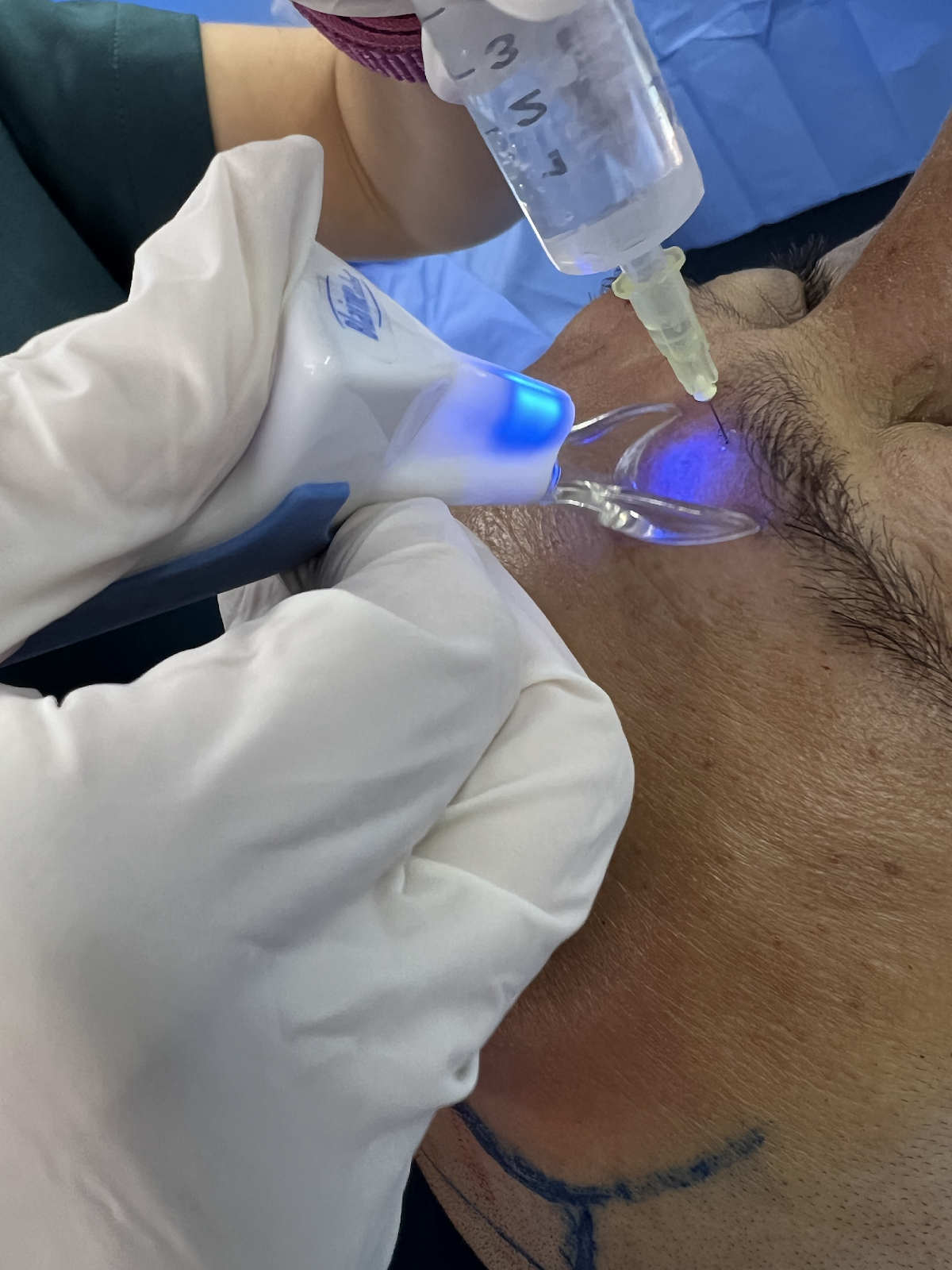
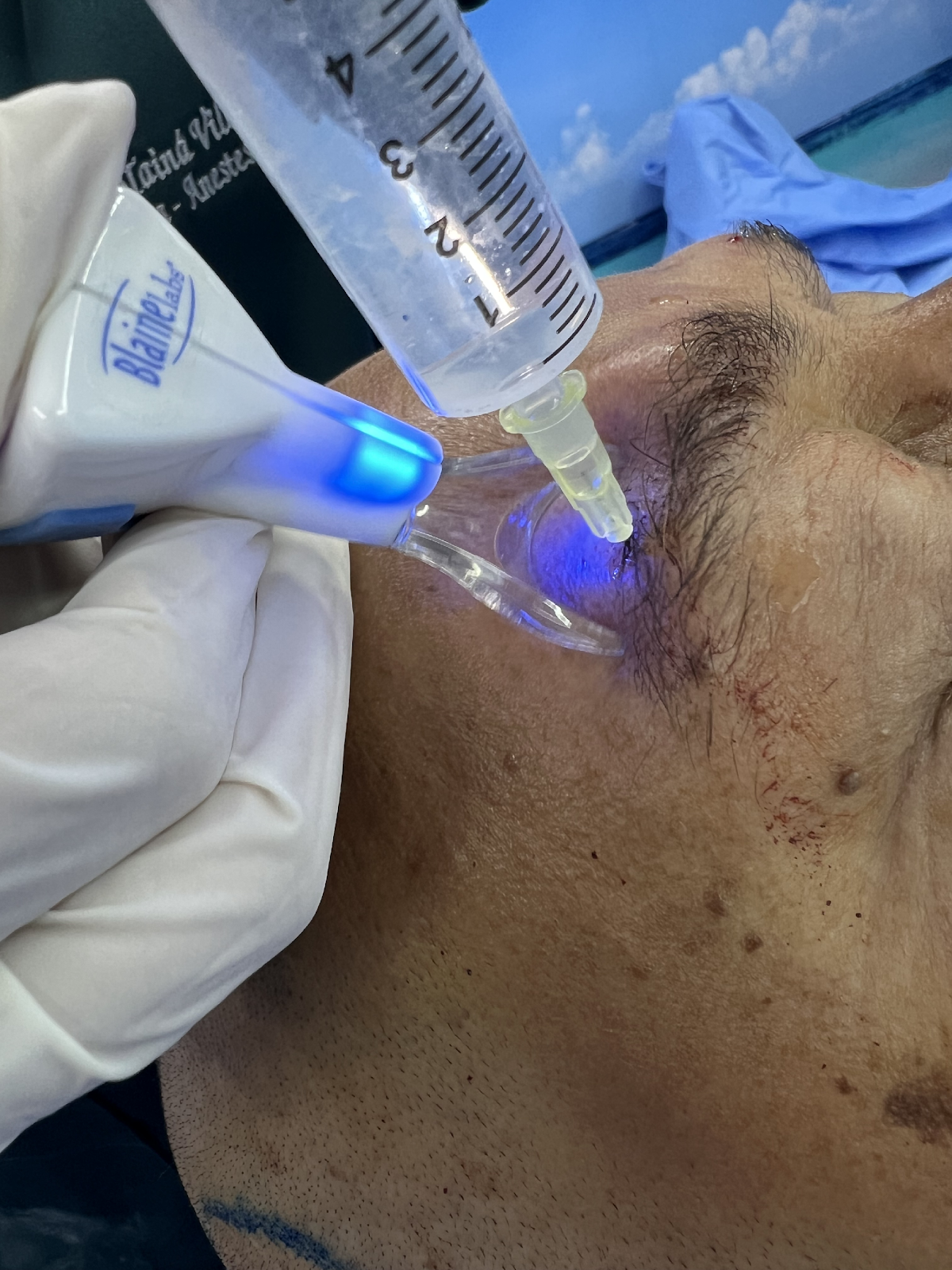
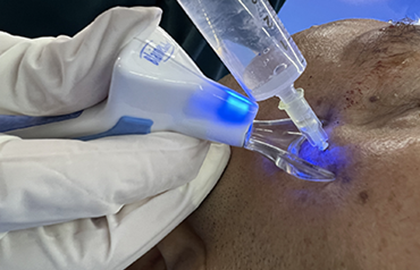
entra na órbita e se divide nos ramos supraorbital e supratroclear. Para os nervos supraorbitais que emergem da foram esupraorbital, identifica-se a linha média pupilar e nesse nível na pálpebra palpa-se o forame supraorbital, 1 cm acima deste, normalmente, logo acima das sobrancelhas, se faz a injeção de anestésico local, aprofunda-se a agulha perpendicularmente à pele até o periósteo afasta-se um pouco e, nessa posição é injetada a solução de anestésico local, de preferência fazendo um leque para melhor dispersão, nessa posição, 1 ml em cada lado, logo após, massagem gentil. Para os nervos supratrocleares, a referência é o ângulo formado entre a sobrancelha e a espinha do nariz, onde o nervo entra em contato com o osso nasal, chega-se com a agulha ao periósteo afasta-se um pouco e injeta-se o anestésico local. Esses nervos correspondem a inervação sensorial do couro cabeludo frontal e testa, além da raiz do nariz.
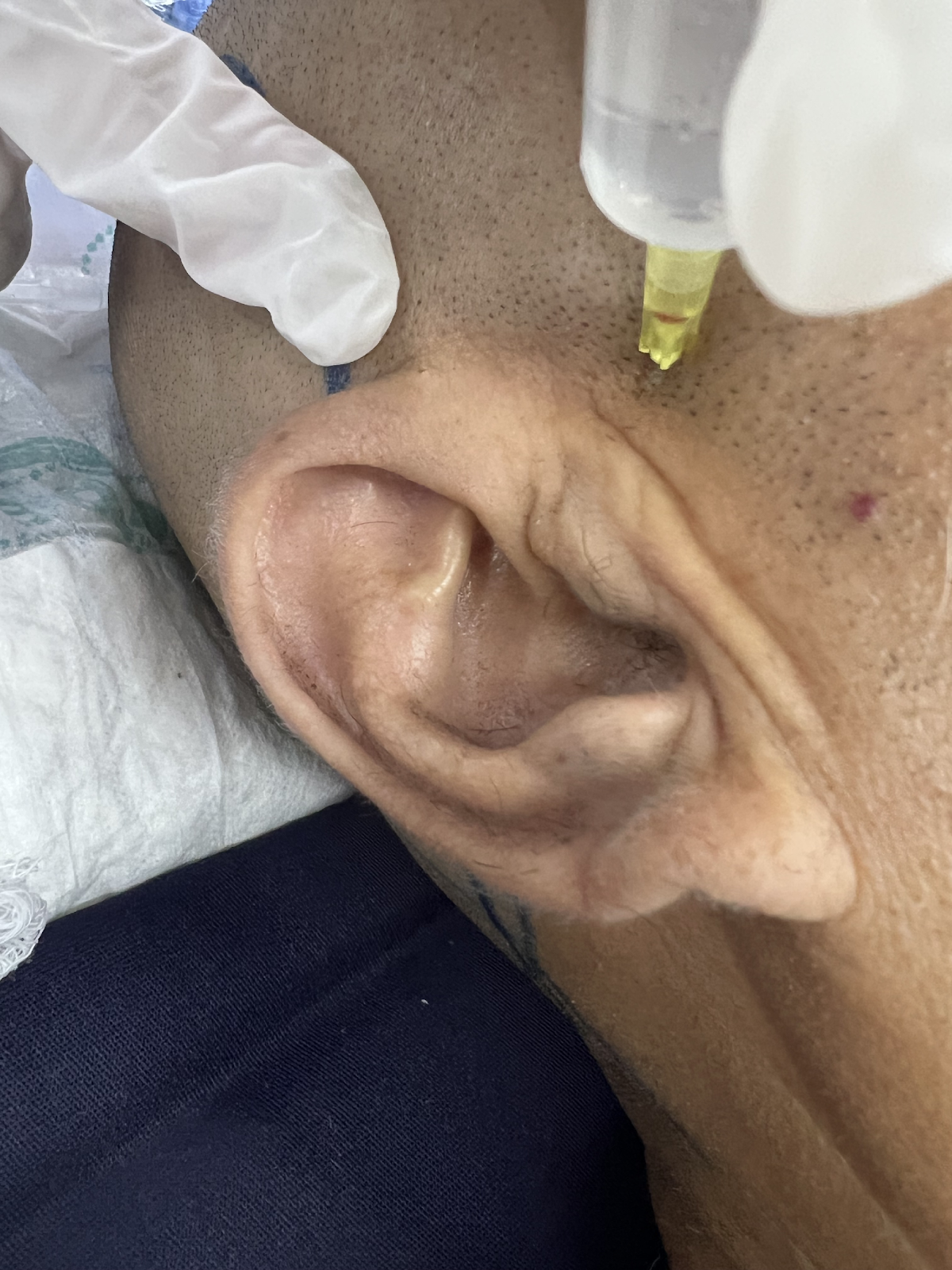
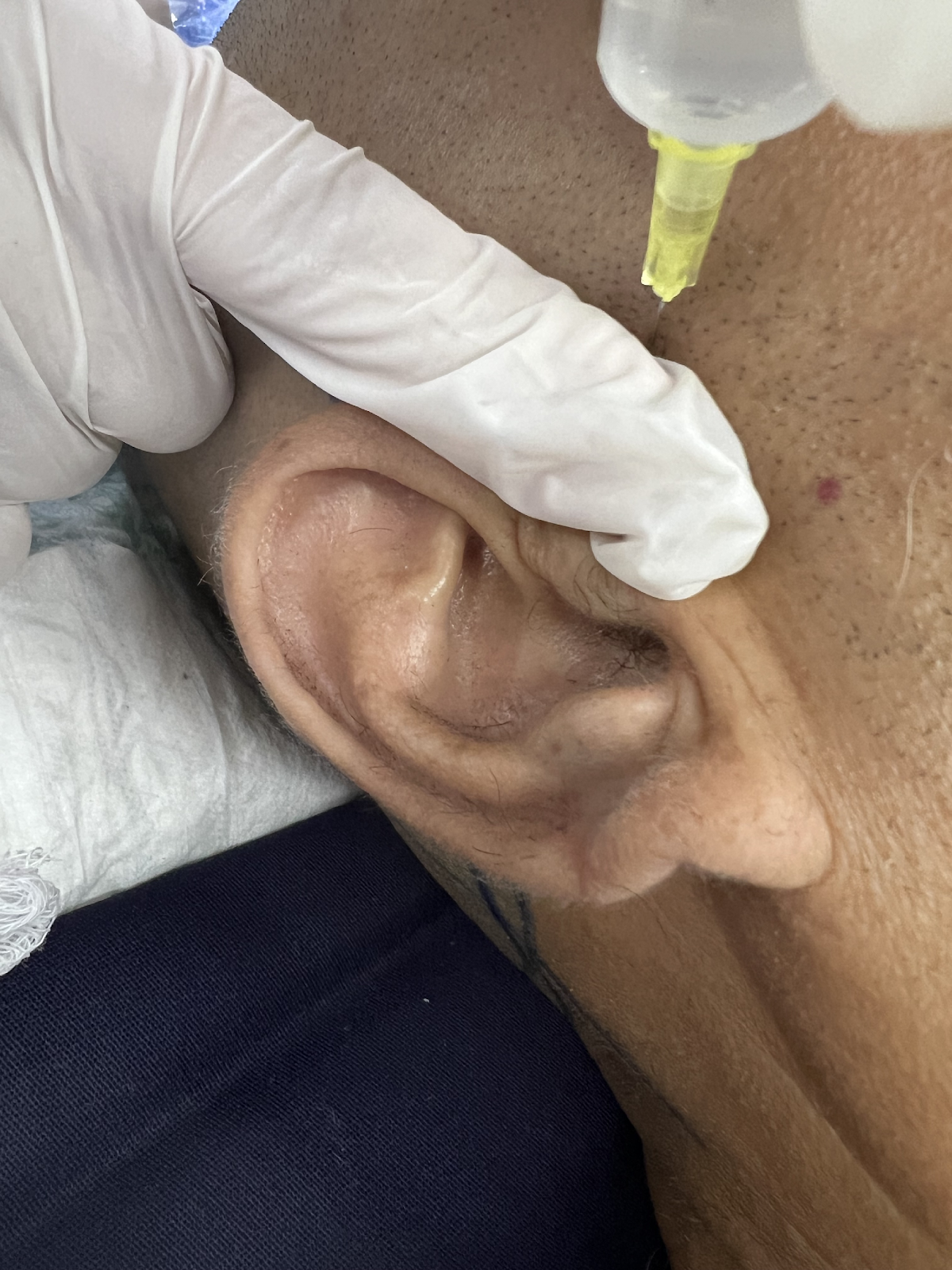
Para os nervos auriculotemporais, palpa-se a artéria auriculotemporal correndo normalmente 1 cm à frente do meato acústico externo e acima da articulação têmporo-mandibular, posiciona-se a agulha inicialmente perpendicular à pele e depois tentando ir para trás da artéria e injeta-se cerca de 1 ml de cada lado, seguido de massagem para melhor dispersão. Responsável pela inervação da orelha externa, mastoide, porção posterior do zigomático, porção anterior da orelha sulco posterior da orelha.
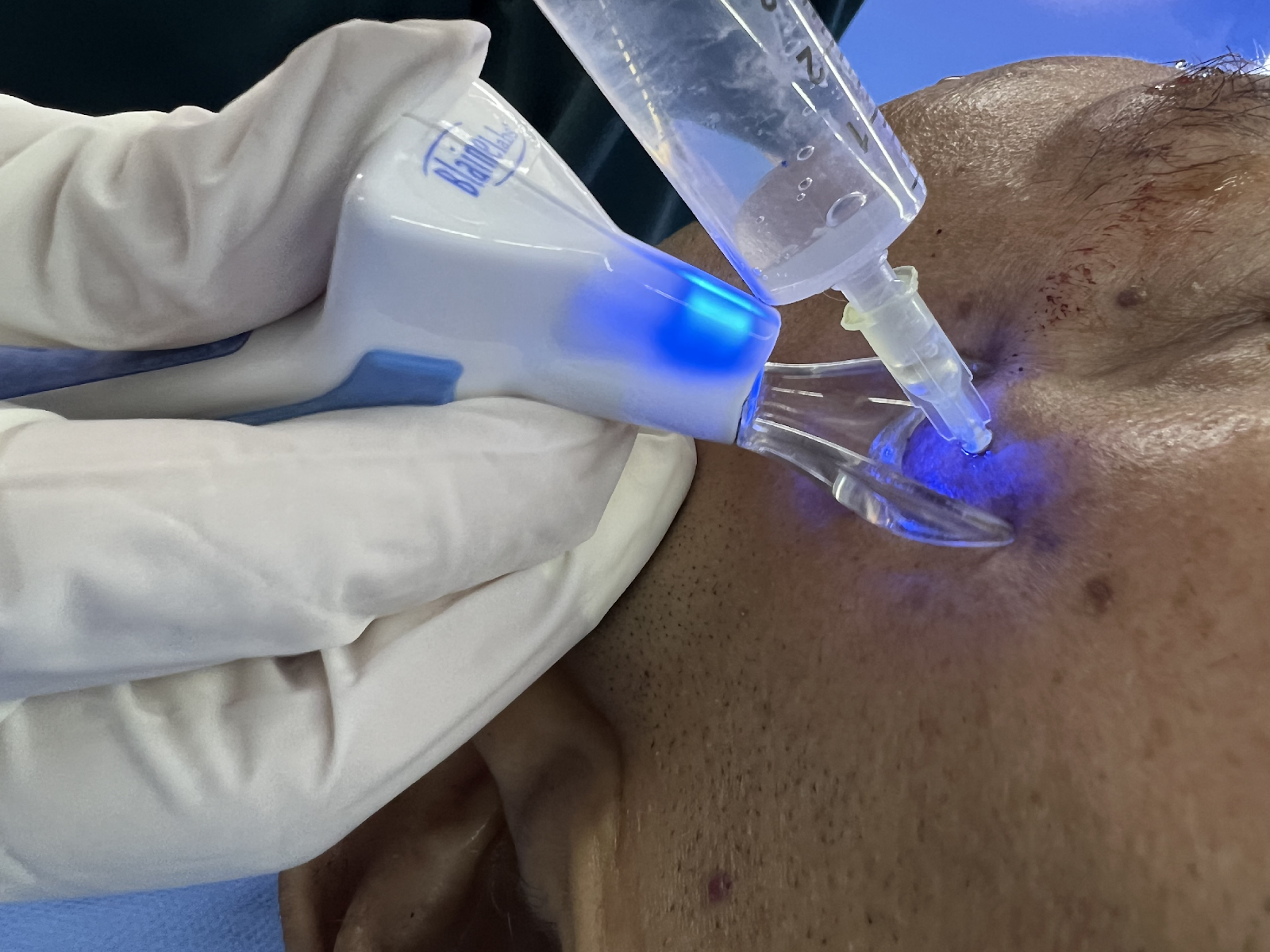
zigomaticotemporais, identifica-se a borda lateral das órbitas e sua intersecção com a linha que passa pelo canto externo dos olhos, nesse ponto costuma estar o nervo. Entra-se com a agulha por trás da borda lateral da órbita e injeta-se aproximadamente 1 ml da solução de cada lado.
Já para os nervos occipitais maiores e menores, é possível a visualização de direta
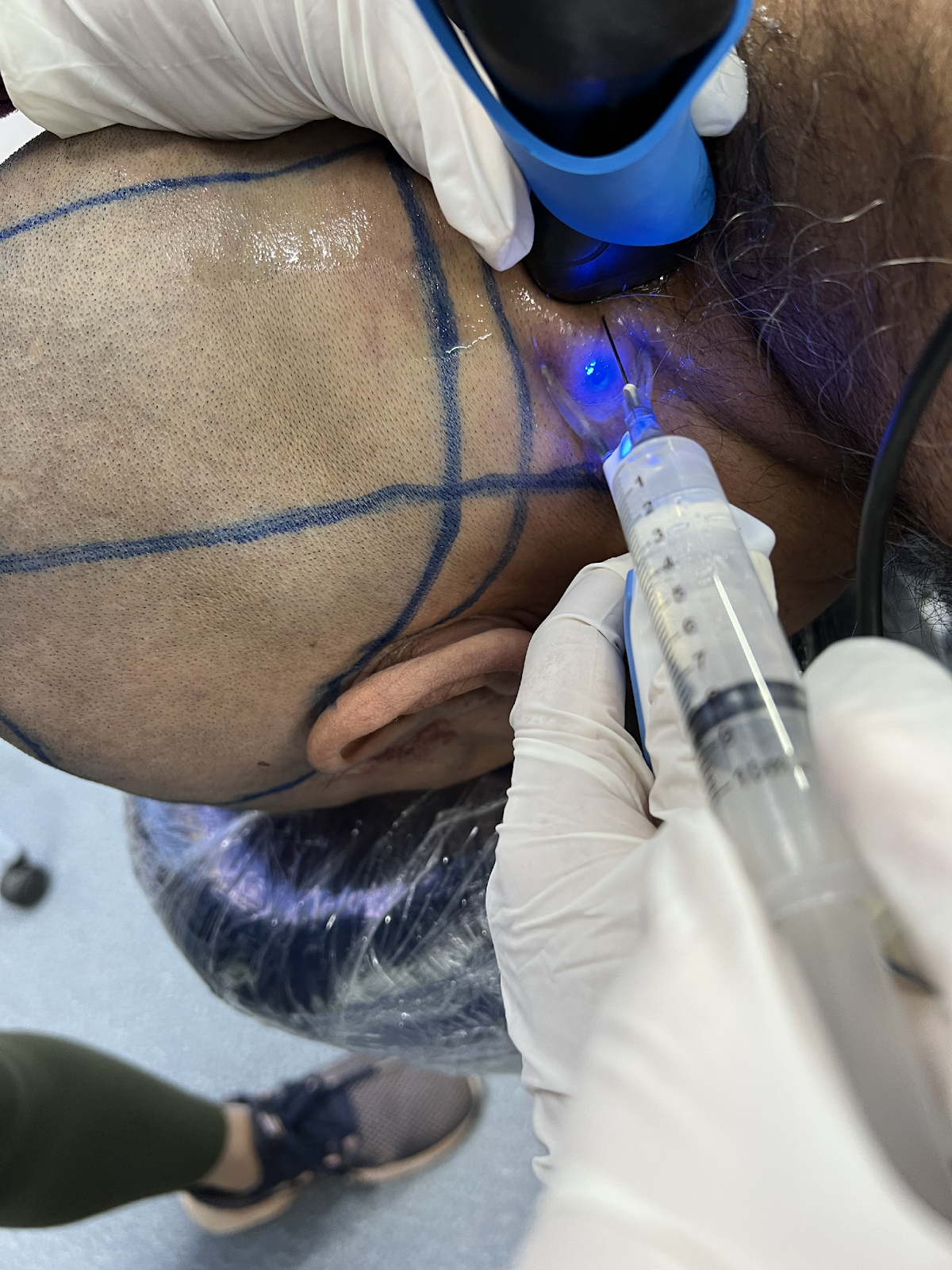
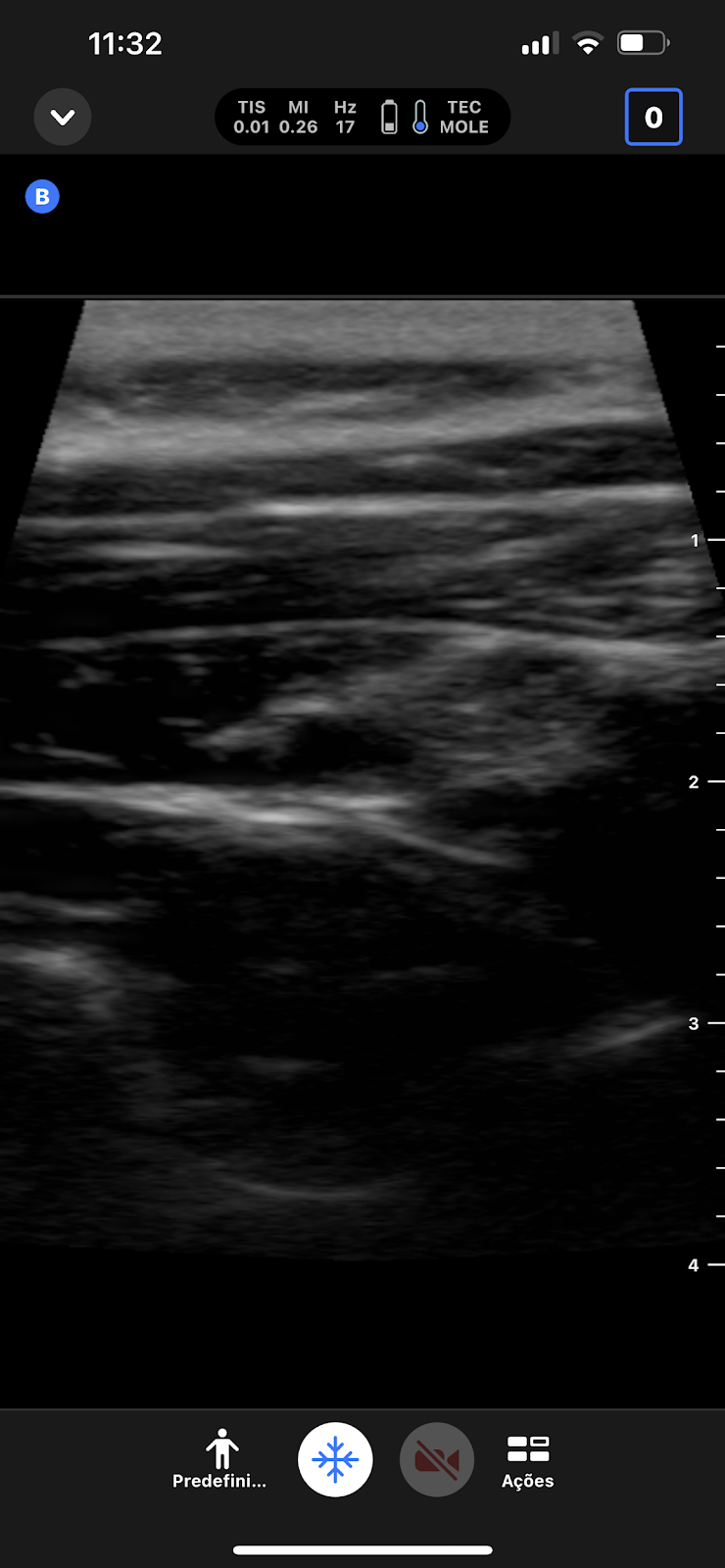
através de ultrassonografia, utilizando-se um transdutor de alta frequência linear, na abordagem cervical. Com o paciente em decúbito dorsal, posiciona-se o prove em cima da protuberância magna do osso occipital, movendo o prove para baixo, teremos a sombra do atlas, movendo ainda mais abaixo, veremos o processo espinhoso do áxis e seus tubérculos laterais bilaterais, a esse nível movemos o probe lateralmente e veremos um músculo-chave, músculo oblíquo inferior ou músculo capilar oblíquo inferior correndo acima da lâmina do áxis, essa é a referência óssea mais importante para esse bloqueio. o nervo occipital maior corre entre o músculo semiespinhal e o oblíquo capilar inferior a meio caminho entre a mastoide e a protuberância occipital. Estes conferem a inervação sensitiva da maior porção posterior do couro cabeludo, da protuberância occipital externa até o vértex.
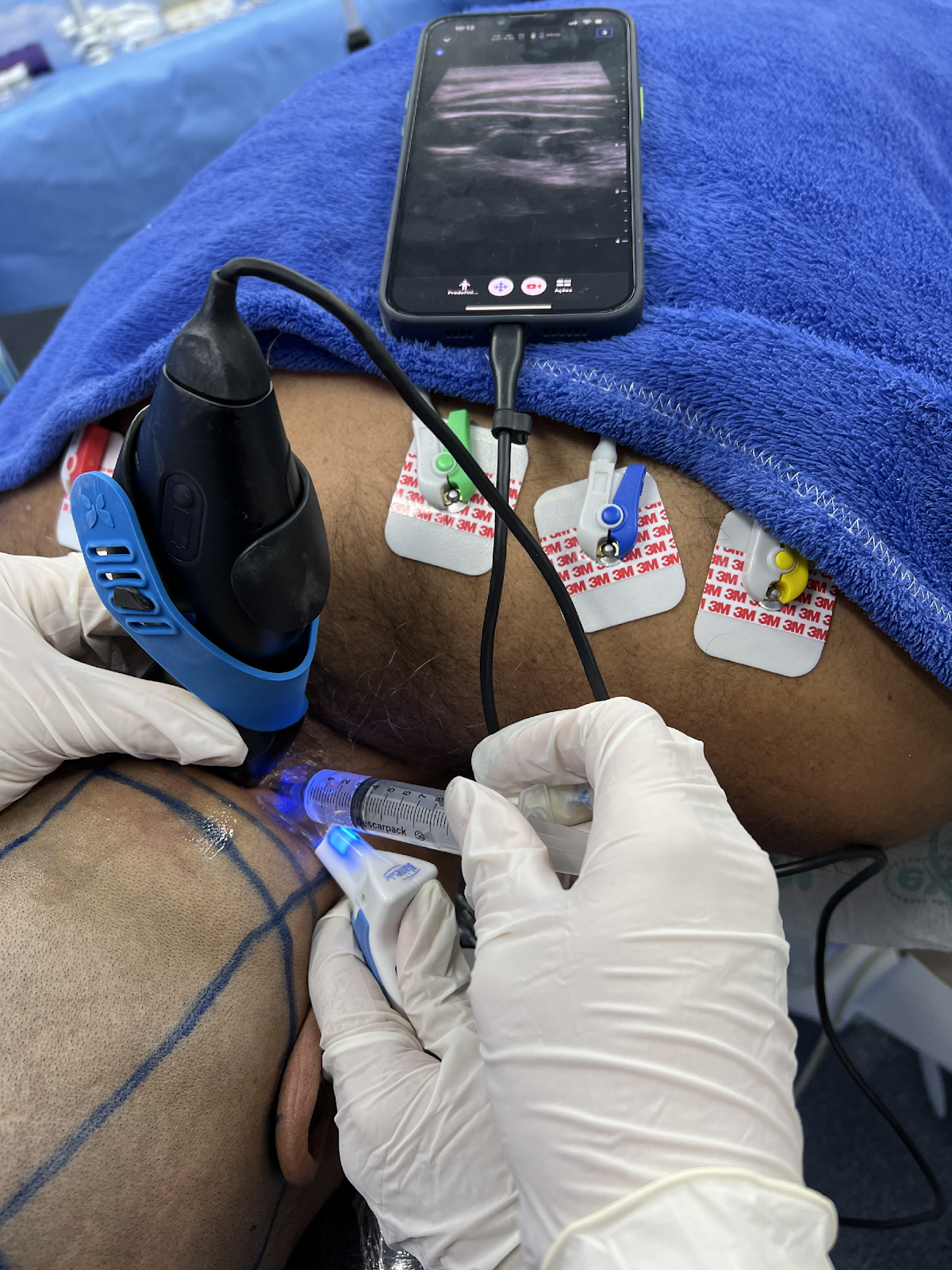
Em geral, usamos no máximo, 15 ml de ropivacaína a 0,3% e assim como todos os bloqueios regionais há um período de latência que precisa ser respeitado, depois de aguardar cerca de 7 minutos, realizamos o teste de sensibilidade e, só depois de confirmada a eficácia do bloqueio, prossegue-se a sedação endovenosa, agora com solução de cetamina e dexmedetomidina. E o paciente adota o decúbito mais adequado para técnica cirúrgica escolhida. Além disso, é utilizado cerca de 3 ml de ropivacaína a 0,3% para infiltração local do couro cabeludo.
MANUTENÇÃO DA ANESTESIA
Para a manutenção da anestesia, normalmente é suficiente o scalp block e infusões intermitentes de fentanil e midazolam em baixas doses, além de monitorização e assistência durante todo o procedimento cirúrgico. Para profilaxia de dor, analgesia preeptiva, cetorolaco endovenoso 30 mg no início do procedimento, assim como dexametasona 4 mg e dipirona 1 g ao final do procedimento. No que concerne à profilaxia de náuseas e vômitos, além de abreviação do jejum, dexametasona no início, ondansetron 4 a 8 mg ao final do procedimento e hidratação restritiva durante o procedimento e vigorosa apenas ao final do procedimento.
Quanto ao tempo de duração do scalp block, ainda não há referência na literatura, mas o que temos observado é um tempo relativamente curto, mesmo se utilizando um anestésico local de perfil farmacocinético adequado, a ropivacaína, dita de longa duração. Observou-se que ao final de 4 horas de procedimento o bloqueio da região frontal da cabeça (nervo supratroclear, supraorbital, zigomaticotemporal e auriculotemporal) tem que ser refeitos para melhor conforto do paciente e menor uso de drogas endovenosas. Assim, normalmente, precisamos fazer reforço da solução de cetamina e dexmedetomidina cerca de 4 horas após o início do procedimento.
PROFILAXIA ANTIBIÓTICA E DE TROMBOSE
A profilaxia antibiótica é mantida até o final do procedimento, sendo realizada através de 2G de cefazolina 30 minutos antes da incisão e a cada 4 horas, além disso mantida por 1 semana com antibiótico via oral, normalmente cefadroxila. A profilaxia de trombose é feita através de botas pneumáticas com pressão de 50 mmHg continuamente, além de em alguns momentos de flutuação da consciência se estimula a deambulação, se possível.
RELATO DE UM CASO
Paciente E. A. C. L., 21 anos, masculino, natural de Caruaru -PE, hígido, com diagnóstico de calvície androgenética, com tratamento medicamentoso há um ano sem o resultado esperado pelo paciente, decidiu, portanto, junto ao médico cirurgião plástico, pela cirurgia de transplante capilar. Usava até uma semana antes da cirurgia minoxidil tópico e dudasterida.
Cerca de 10 dias antes do procedimento passou por consulta on-line com a médica anestesiologista da equipe para conhecimento do paciente e de suas implicações de saúde, planejamento da anestesia, elucidação de possíveis dúvidas e manejo da ansiedade do paciente. Esse momento se trata ainda de uma janela de oportunidade para possíveis diagnósticos e ainda incentivo a um estilo de vida mais saudável.
Em consulta pré-anestésica não foi identificada nenhuma comorbidade do paciente, se trata de um paciente previamente hígido, eutrófico, com nível de ansiedade normal, haja vista a mudança de vida que estava prestes a ser submetido, após conversa, se mostrou feliz e confiante na equipe e no procedimento escolhido: transplante capilar pela técnica de FUE (Follicular Unit Extraction).
No pré-operatório, foi indicado iniciar dipirona 1 g e paracetamol 750 mg a cada 6 horas, 48 horas, antes do procedimento e pregabalina 75 mg 24 horas antes, estes tendo sido realizados pelo paciente. No que concerne ao jejum, foi orientado 6 horas para sólidos leves e 2 horas para líquidos claros sem resíduos. Orientado ainda, abreviação do jejum, tendo tomado suco de laranja coado com açúcar 2 horas antes da chegada na clínica.
Na clínica a equipe já estava à sua espera, foram feitas as fotos do antes, realizada a tricotomia da cabeça e ao final iniciada a anestesia com midazolam 15 mg via oral. Ao entrar na sala operatória foi feita uma venóclise com jelco 20G, em face anterior do antebraço direito, sem intercorrências e prossegui-se a monitorização essencial e sedação endovenosa para melhor conforto do paciente, com midazolam 2 mg e fentanil 50 mcg. Preparada a solução de anestésico local com ropivacaína a 0,3%, a partir daí é possível o bloqueio dos nervos que invertam o couro cabeludo com mais tranquilidade, e assim o fizemos. Primeiramente, os nervos da região frontal, supratrocleares e supraorbitais bilaterais com 1ml de solução de anestésico local; zigomaticotemporais bilaterais com mais 1ml da solução de cada lado e auriculotemporais com mais 1,5ml da solução de cada lado.
Com o paciente ainda vigil e cooperativo, solicitamos que se colocasse agora em decúbito ventral e, a seguir, bloqueamos os occipitais maior e menor guiado por US (modelo Butterfly iQ+ multifuncional), com mais cerca de 6 ml da solução de anestésico local. Nesse momento, também se faz necessário um pouco mais de analgesia; optamos por solução de cetamina e dexmedetomidina cerca de 3 ml, pois o bloqueio é realizado com agulha 27 x 0,8 mm. Seguiu-se, então, a extração dos folículos, sem intercorrências e sem necessidade de infiltração local ou novo bloqueio de nervo periférico.
Após aproximadamente 3 horas de extração da região occipital, se fez necessário pelo número de folículos, extrair da região temporal bilateralmente; nessa região o paciente queixou-se de dor e foi realizado também infiltração local com cerca de 2 ml de ropivacaína a 0,3% e 2 ml lidocaína a 0,5%, podendo, a partir daí, o procedimento continuar tranquilamente.
Foram retiradas 4000 unidades foliculares e, então, o paciente foi colocado em decúbito dorsal, tomou cerca de 200 ml de suco coado com açúcar, 100 ml de água recebeu nova dose de midazolam e novo bloqueio dos nervos frontais do couro cabeludo (mais 4 ml da solução), para serem realizadas as incisões para posterior implantação dos folículos. Essa fase também ocorreu sem intercorrências ou queixas do paciente, percorrendo-se aí mais de 3 horas de procedimento.
Nas últimas três horas, não foi administrado pelo anestesiologista mais nenhum tipo de medicação anestésica intravenosa e o paciente se manteve sem dor, por conta do bloqueio de nervo periférico, e tranquilo do ponto de vista emocional. Ali teve acesso a televisão, músicas, troca de experiências com a equipe, enquanto se implantavam fio a fio os folículos. Ao fim do procedimento, realizamos hidratação vigorosa com 500 ml de solução de ranger lactado, 8 mg de ondansetron, o paciente se levantou, urinou e se alimentou de sólidos normalmente.
Com relação ao perfil hemodinâmico do paciente, este manteve-se o tempo todo com pressão média de 60 mmHg, frequência cardíaca médica de 70 bpm, saturação de oxigênio média de 98%, temperatura axilar medida intermitentemente, inicial 36,2 graus celsius, no ínterim 35,6 e, ao final do procedimento, 35,1.
Mediu-se o grau de satisfação do paciente, no intraoperatório, que relatou total conforto e satisfação, apenas reclamou de um pouco de tontura ao tentar ir ao banheiro no meio do procedimento, totalmente explicável pela hipotensão e bradicardia induzidas para melhor campo cirúrgico. Com relação ao pós-operatório imediato, sem queixas ativas, sem dor ou náuseas e vômitos. No terceiro dia pós-operatório queixou-se de leve edema na região central da testa, mas que durou apenas 24 horas. Até a confecção deste artigo, paciente totalmente satisfeito com todo o caminho perioperatório.
REFERÊNCIAS
01. Armitage EN - Postoperative pain-prevention or relief? Br J Anaesth, 1989;63:136-138.
02. Mitchell RWD, Smith G - The control of acute postoperative pain. Br J Anaesth, 1989;63:147-158.
03. Wildsmith FAW - Aspects of pain. Br J Anaesth, 1989;63:135.
04. Crile GW - The kinetic theory of shock and its prevention through anoci-association (shockless operation). Lancet, 1919;185: 7-16.
05. Woolf CJ - Evidence for a central component of post-injury pain hypersensitivity. Nature, 1983;306:686-688.
06. McQuay HJ, DIckenson AH - Implications of nervous system plasticity for pain management. Anaesthesia, 1990;45: 101-102.
07. McQuay HJ - Preemptive analgesia. Br J Anaesth, 1992;69:1-3.
08. Kissin I - Preemptive analgesia - why its effect is not always obvious. Anesthesiology, 1996;84:1015-1019.
09. Aguilar-Nascimento JE, Bicudo-Salomão A,Caporossi C, Silva RM, Cardoso EA, Santos TP. Acerto pós-operatório: avaliação dos resultados da implantação de um protocolo multidisciplinar de cuidados peri-op
Edição 26, artigo 4.
English version
Perioperative Hair Transplant Protocol
Description of perioperative care technique and report of a model case
Dr. Thiago Lins do Vale
Plastic Surgeon
Specialist member - SBCP, ABCRC and ASPS
Dra. Tainá Lima Reis Vilaça
Anesthesiologist
Graduated from the Federal University of Maranhão - UFMA
Medical Residency at the State University of Campinas - UNICAMP
Specialization in Ultrasound Guided Regional Anesthesia at Hospital Sírio-Libanês
PERIOPERATIVE CARE
The perioperative period comprises the preoperative, intraoperative, and postoperative periods, that is, from the moment the patient is aware of his diagnosis and decides to undergo surgery until recovery and rehabilitation.
Medical practice has been surprisingly rapidly incorporating new knowledge related to surgery and minor surgical procedures. Technological resources and the technical improvement of the teams increased the level of confidence of physicians and patients. Consecutive successes, associated with a lower rate of postoperative complications, resulted in the expansion of the surgical population.
Preoperatively, an optimal evaluation of the patient is necessary, both by the surgeon and the anesthesiologist, to identify factors that may interfere with the safety and outcome of the surgery and the degree of patient satisfaction. In this regard, it is important to have an adequate pre-anesthetic evaluation and a free communication path between surgeon and anesthesiologist for better perioperative management of the patient.
In the first contact between anesthesiologist and patient, it is possible to create a relationship of trust that becomes fundamental throughout the anesthetic-surgical process. At this moment, the importance of preemptive analgesia is also included.
CONCEPT OF PREEMPTIVE ANALGESIA
Postoperative pain control has generated a lot of interest, especially in recent decades, when postoperative analgesia was found to be inadequately performed, despite advances in the understanding of pain physiology, the mechanism of action and the development of sophisticated medication administration systems, and there is a need for progress in this area (1-3).
Within this context, some treatment modalities have been discussed, such as preemptive analgesia. The term “preemptive” implies a form of analgesia that, initiated before the painful stimulus is generated, prevents, or reduces subsequent pain. The concept of preemptive analgesia was initially formulated in the first decade of the 20th century, when the association of regional anesthesia and general anesthesia was recommended to prevent pain caused by changes in the central nervous system during surgery, due to non-suppression of painful stimulus conduction for the encephalon. This idea was refreshed by Woolf who studied animals subjected to intense nociceptive stimuli and observed that sensory alterations were generated (continuous pain, increased painful sensitivity and pain in response to non-painful stimuli), later explained, not only by changes occurring through of peripheral mechanisms, but also by changes (hyperexcitability) in spinal cord activity (4).
In an experimental study, Woolf et al. described that, once the hyperexcitability of medullary neurons is established, extremely high doses of morphine are necessary to block this state, whereas, with small doses administered before the stimuli reach the central nervous system, suppression of excitability is obtained. This information showed that preoperative pain management could prevent a state of spinal cord hyperexcitability (5, 10).
The purpose of preemptive analgesia is to prevent or reduce the development of any “memory” that pain would cause in the central nervous system, resulting in less need for analgesics.
From the definition that preemptive analgesia is a preoperative intervention that prevents or reduces postoperative pain, the difference between the results of analgesia performed before and after the start of an operation would show a preemptive effect. However, more emphasis should not be given only to the moment of the beginning of the treatment, but to the physiopathological phenomenon that must be prevented: the change of the sensorial processing (11, 12).
Results obtained through preoperative or pre-incisional interventions, which are not able to prevent central alterations, should not be considered preemptive, as preemptive does not mean just “previous.”
ROLE OF PREGABALIN
Adding new adjuvant drugs such as gabapentinoids to a multimodal analgesic regimen, which have been shown to be effective in postoperative analgesia in different procedures, may be reasonable to reduce postoperative pain scores, total opioid consumption, and the side effects after percutaneous nephrolithotomy. Pregabalin is a structural analogue of gamma-aminobutyric acid (GABA), an inhibitory neurotransmitter, with anticonvulsant, antihyperalgesic and anxiolytic properties like gabapentin, but with a more adequate pharmacokinetic profile.
PRE-OPERATIVE FASTING
Regarding preoperative fasting, the most recent abbreviation guidelines was adopted, which recommends eight hours for heavy solids, six hours for light solids and two hours for liquids without residues. And two hours before the procedure, intake of a clear liquid without residues and rich in glucose, which may be maltodextrin 25 g in 200 ml of water, industrialized preparations of isolated protein 200 ml or strained fruit juice sweetened with sugar 200 ml. Thus, to shorten preoperative fasting, drinks containing carbohydrates have been used and recommended, due to rapid gastric emptying and improvement in insulin resistance related to surgical trauma. This recommendation was recently validated in Brazil by the ACERTO project (13).
HOW WE DO IT IN OUR CONTEXT
Initially, the patient undergoes a complete anesthetic evaluation, identifying specificities, degree of anxiety and complications of the surgery; guidelines regarding the anesthetic-surgical process, which anesthetic technique is normally used, preceptive analgesia and postoperative care. In our context, as preemptive analgesia we used dipyrone 1 g and paracetamol 750 mg every 6h alternately and pregabalin 75 mg 5 to 7 days before the procedure
TRANSOPERATIVE CARE
The perioperative period ranges from the moment the patient is received in the operating room until the moment of being transferred to the Anesthetic Recovery Unit, it is normally considered a critical period for the patient. Especially when this is a plastic surgery in which the patient effectively chose to be there and expects only the best result and, in the end, an improvement in self-esteem.
Upon arriving at the surgical center, the patient is properly welcomed and introduced to the team related to the surgery - each one introduces himself by name, as part of the entire process of humanization of care and anxiolysis. Then, he proceeds to the studio to have the photos taken before the procedure. And only then is the scalp prepared depending on the technique chosen and whether the hair will be shaved. During this procedure, we try to make the patient as calm as possible and, also, pharmacological intervention is given through oral midazolam or diazepam.
The patient is accompanied to the operating room and there, venipuncture, essential static hemodynamic monitoring (cardioscopy, non-invasive blood pressure, axillary temperature, pulse oximetry) are performed, pneumatic boots are also placed, antibiotic prophylaxis, non-steroidal anti-inflammatory drugs and intravenous sedation - at this time, midazolam and fentanyl, so that the patient is as comfortable as possible for the nerve blocks that innervate the scalp: supratrochlear, supraorbital, zygomatic, auriculotemporal, greater occipital nerves and smaller, bilaterally - SCALP BLOCK. The greater and lesser occipital nerves are preferably performed using ultrasound. In addition, for prophylaxis of excessive bleeding, mechanical positioning techniques are used, as well as medication, with the use of antifibrinolytics, in our routine 30 mg/kg of tranexamic acid.
SCALP BLOCK
Regional anesthesia of the head and face nerves is commonly used to manage postoperative pain by reducing complaints and consumption of analgesic medication, including opioids related to head and neck surgeries. As the cranial and cervical nerves are closely related to vital structures in a compact area, the effectiveness and safety of head blocks are based on an accurate and detailed knowledge of the anatomical relationship of each nerve, its superficial and deep course, and sensory dermatome related.
First, a local anesthetic solution is prepared with 0.3% ropivacaine, about 15 ml, to perform the entire scalp block, for the frontal and lateral nerves of the head, a 13 x 0.30 mm hypodermic needle is used, for the nerves at the back of the head, a 25 x 0.70 mm needle is required.
We initially identified the frontal nerve (supraorbital and supratrochlear branch), it
enters the orbit and divides into the supraorbital and supratrochlear branches. For the supraorbital nerves that emerge from the supraorbital foramen, the pupillary midline is identified and at this level on the eyelid, the supraorbital foramen is palpated, 1 cm above it, normally just above the eyebrows, a local anesthetic is injected, deepened -if the needle is perpendicular to the skin towards the periosteum, move away a little and, in this position, the local anesthetic solution is injected, preferably making a fan for better dispersion, in this position, 1 ml on each side, right after, a gentle massage. For the supratrochlear nerves, the reference point is the angle formed between the eyebrow and the spine of the nose, where the nerve meets the nasal bone, the needle is placed in the periosteum, moved away a little and the anesthetic is injected place. These nerves correspond to the sensory innervation of the frontal scalp and forehead, in addition to the root of the nose.
For the auriculotemporal nerves, the auriculotemporal artery is palpated, normally running 1 cm in front of the external acoustic meatus and above the temporomandibular joint. The needle is initially positioned perpendicular to the skin and then trying to go behind the artery and inject about 1 ml on each side, followed by massage for better dispersion. Responsible for the innervation of the external ear, mastoid, posterior portion of the zygomaticus, anterior portion of the ear, posterior sulcus of the ear.
zygomaticotemporalis, identify the lateral edge of the orbits and their intersection with the line passing through the outer corner of the eyes, where the nerve is usually located. Needle is inserted behind the lateral edge of the orbit and approximately 1 ml of the solution is injected on each side.
As for the greater and lesser occipital nerves, it is possible to visualize them directly
através de ultrassonografia, utilizando-se um transdutor de alta frequência linear, na abordagem cervical. Com o paciente em decúbito dorsal, posiciona-se o prove em cima da protuberância magna do osso occipital, movendo o prove para baixo, teremos a sombra do atlas, movendo ainda mais abaixo, veremos o processo espinhoso do áxis e seus tubérculos laterais bilaterais, a esse nível movemos o probe lateralmente e veremos um músculo-chave, músculo oblíquo inferior ou músculo capilar oblíquo inferior correndo acima da lâmina do áxis, essa é a referência óssea mais importante para esse bloqueio. o nervo occipital maior corre entre o músculo semiespinhal e o oblíquo capilar inferior a meio caminho entre a mastoide e a protuberância occipital. Estes conferem a inervação sensitiva da maior porção posterior do couro cabeludo, da protuberância occipital externa até o vértex.
In general, we use a maximum of 15 ml of 0.3% ropivacaine and, like all regional blocks, there is a latency period that needs to be respected, after waiting about seven minutes, we perform the sensitivity test and, only after that, once the effectiveness of the blockade is confirmed, intravenous sedation is continued, now with a solution of ketamine and dexmedetomidine. And the patient adopts the most appropriate position for the chosen surgical technique. Additionally, approximately 3 ml of 0.3% ropivacaine is used for local infiltration of the scalp.
MAINTENANCE OF THE ANESTHESIA
To maintain anesthesia, a scalp block and intermittent infusions of low-dose fentanyl and midazolam are usually sufficient, in addition to monitoring and assistance throughout the surgical procedure. For pain prophylaxis, preemptive analgesia, intravenous ketorolac 30 mg at the beginning of the procedure, as well as dexamethasone 4 mg and dipyrone 1 g at the end of the procedure. Regarding the prophylaxis of nausea and vomiting, in addition to fasting abbreviation, dexamethasone at the beginning, ondansetron 4 to 8 mg at the end of the procedure and restrictive hydration during the procedure and vigorous only at the end of the procedure.
As for the duration of the scalp block, there is still no reference in the literature, but a relatively short time was observed, even when using a local anesthetic with an adequate pharmacokinetic profile, ropivacaine, said to be long-lasting. At the end of the 4-hour procedure, the blockade of the frontal region of the head (supratrochlear, supraorbital, zygomaticotemporal and auriculotemporal nerves) had to be redone for better patient comfort and less use of intravenous drugs. So, normally, we need to boost the ketamine and dexmedetomidine solution about 4 hours after starting the procedure.
ANTIBIOTIC PROPHYLAXIS AND THROMBOSIS
Antibiotic prophylaxis is maintained until the end of the procedure, being performed through 2g of cefazolin 30 minutes before the incision and every four hours, in addition maintained for one week with oral antibiotics, usually cefadroxil. Thrombosis prophylaxis is conducted using pneumatic boots with a pressure of 50 mmHg continuously, additionally to encouraging walking in some moments of fluctuation in consciousness, if possible.
CASE REPORT
Patient E.A.C.L., 21 years old, male, born in Caruaru -PE, healthy, with diagnosis of androgenetic baldness, with drug treatment for a year without the result expected by the patient, therefore, together with the plastic surgeon, decided for the hair transplant surgery. I used topical minoxidil and dutasteride up to a week before surgery. About 10 days before the procedure, he went through an online consultation with the team's anesthesiologist to know the patient and its health implications, plan the anesthesia, clarify doubts, and manage the patient's anxiety. This moment is still a window of opportunity for diagnoses and even encouragement for a healthier lifestyle. In the pre-anesthetic consultation, no comorbidity was identified in the patient. He is a previously healthy, eutrophic patient, with a normal level of anxiety, given the change in life he was about to undergo. After the conversation, he was happy and confident in the team and in the chosen procedure: hair transplant using the FUE (Follicular Unit Extraction) technique. In the preoperative period, it was indicated to start dipyrone 1 g and paracetamol 750 mg every six hours, 48 ??hours before the procedure and pregabalin 75 mg 24 hours before, these having been performed by the patient. Regarding fasting, he was advised six hours for light solids and two hours for clear liquids without residues. He was also instructed to shorten the fast, having had orange juice strained with sugar two hours before arriving at the clinic. At the clinic, the team was already waiting for him, the before photos were taken, the head was shaved and, at the end, anesthesia was started with midazolam 15 mg orally. Upon entering the operating room, a venoclysis was performed with a 20g Jelco, on the anterior surface of the right forearm, without intercurrences, and essential monitoring and intravenous sedation were continued for better patient comfort, with midazolam 2 mg and fentanyl 50 mcg. A local anesthetic solution with 0.3% ropivacaine was prepared, from there it is possible to block the nerves that invert the scalp more calmly, and we did so. Firstly, the frontal nerve, supratrochlear nerve, and bilateral supraorbital nerve with 1ml of local anesthetic solution; bilateral zygomaticotemporalis with another 1ml of the solution on each side and auriculotemporal with another 1.5ml of the solution on each side. With the patient still alert and cooperative, we asked him to be in the prone position and then, we blocked the greater and lesser occiputs guided by US (Multifunctional Butterfly iQ+ model), with approximately 6 ml of local anesthetic solution. At that moment, a little more analgesia is also necessary; a 3ml ketamine and dexmedetomidine solution was chosen, as the blockade is performed with a 27 x 0.8 mm needle. The follicles were then extracted, uneventfully and without the need for local infiltration or a new peripheral nerve block. After approximately three hours of extraction from the occipital region, if necessary due to the number of follicles, extract from the temporal region bilaterally; in this region, the patient complained of pain and a local infiltration was also performed with approximately 2 ml of 0.3% ropivacaine and 2 ml of 0.5% lidocaine, allowing the procedure to continue smoothly thereafter. 4000 follicular units were removed and then the patient was placed in dorsal decubitus position, drank about 200 ml of juice strained with sugar, 100 ml of water, received a new dose of midazolam and a new blockade of the frontal nerves of the scalp (another 4 ml of the solution), to make the incisions for posterior implantation of the follicles. This phase also occurred uneventfully or without complaints from the patient, with more than three hours of procedure. In the last three hours, the anesthesiologist did not administer any other type of intravenous anesthetic medication and the patient remained pain-free, due to the peripheral nerve block, and calm from an emotional point of view. There, he accessed television, music, exchange of experiences with the team, while the follicles were implanted hair by hair. At the end of the procedure, a vigorous hydration with 500 ml of lactated ranger solution, 8 mg of ondansetron, was performed; the patient got up, urinated, and ate solids normally. Regarding the patient's hemodynamic profile, he was always maintained with a mean pressure of 60 mmHg, medical heart rate of 70 bpm, mean oxygen saturation of 98%, axillary temperature measured intermittently, initial 36.2 degrees Celsius, at meanwhile 35.6 and, at the end of the procedure, 35.1. The patient's satisfaction was measured intraoperatively, who reported complete comfort and satisfaction, only complaining of a little dizziness when trying to go to the bathroom in the middle of the procedure, fully explained by the hypotension and bradycardia induced for a better surgical field. Regarding the immediate postoperative period, there were no active complaints, no pain or nausea and vomiting. On the third postoperative day, he complained of a slight swelling in the central region of his forehead, which lasted only 24 hours. Until the writing of this article, the patient was completely satisfied with the entire perioperative path.
REFERENCES
01. Armitage EN - Postoperative pain-prevention or relief? Br J Anaesth, 1989;63:136-138. 02. Mitchell RWD, Smith G - The control of acute postoperative pain. Br J Anaesth, 1989;63:147-158. 03. Wildsmith FAW - Aspects of pain. Br J Anaesth, 1989;63:135. 04. Crile GW - The kinetic theory of shock and its prevention through anoci-association (shockless operation). Lancet, 1919;185: 7-16. 05. Woolf CJ - Evidence for a central component of post-injury pain hypersensitivity. Nature, 1983;306:686-688. 06. McQuay HJ, DIckenson AH - Implications of nervous system plasticity for pain management. Anaesthesia, 1990;45: 101-102. 07. McQuay HJ - Preemptive analgesia. Br J Anaesth, 1992;69:1-3. 08. Kissin I - Preemptive analgesia - why its effect is not always obvious. Anesthesiology, 1996;84:1015-1019. 09. Aguilar-Nascimento JE, Bicudo-Salomão A,Caporossi C, Silva RM, Cardoso EA, Santos TP. Acerto pós-operatório: avaliação dos resultados da implantação de um protocolo multidisciplinar de cuidados peri-op
Issue 26, article 4.

