
New Strategies for Using Grafts Harvested from Outside the Safe Zone
Robert H. True, MD, MPH, FISHRS
Artigo comentado por Dr. Lucas Telles
Conflitos de interesse: nenhum
Introdução
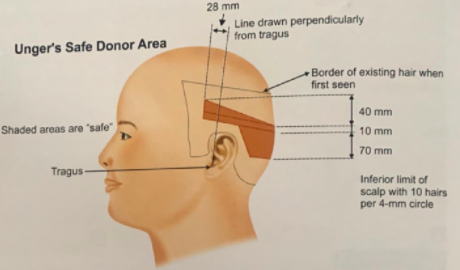
Nos últimos anos, temos visto uma predominância do método FUE como técnica escolhida na retirada das Unidades Foliculares no transplante capilar. E, como consequência, também notamos um aumento da coleta de folículos situados fora dos limites da clássica “Safe Donor Area” (SDA) descrita pelo Dr. Walter Unger (figura 1). Os motivos principais para este fato seriam:
1) Megassões que necessitam mais de 2500 UFs;
2) Necessidade de manter a área doadora homogênea, evitando o “overharvesting”.
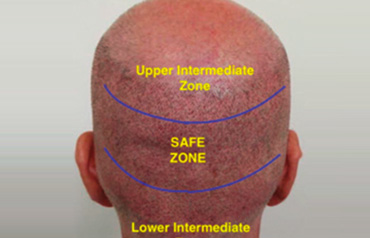
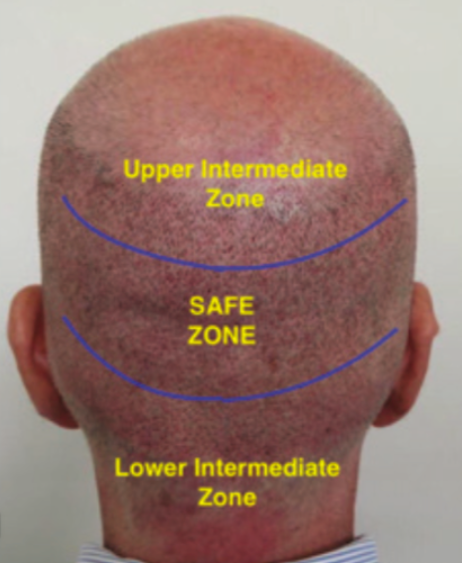
A abordagem de folículos fora da SDA pode ser utilizada, mas devemos levar em consideração alguns riscos. O autor classifica como áreas intermediárias (figura 2) as regiões logo acima e logo abaixo da SDA tradicional. Nestas regiões, os folículos ainda são predispostos à ação androgênica da Diidrotestosterona (DHT) e poderiam vir a sofrer miniaturização com o tempo. Outro grande risco de se coletar folículos dessas regiões seria a colocação destas de forma concentrada na região receptora, em blocos, causando falhas aparentes e um resultado inestético. O autor sugere algumas estratégias para a ideal utilização dessas unidades, tendo como inspiração o trabalho do Dr. Sebastian Yrariat em cirurgias reparadoras de couro cabeludo: Potentially Androgenic Hair Transplantation (PAHT).
Objetivos
Otimizar o uso de unidades foliculares oriundas da zona doadora intermediária possivelmente androssensível ampliando a possibilidade e a disponibilidade de fios para um transplante capilar.
Discussão
Possuímos algumas regiões do couro cabeludo resistentes à ação da DHT e, por isso, são chamadas de áreas seguras. Logo acima e logo abaixo destas, existem as zonas intermediárias superior e inferior, que podem ou não terem sensibilidade à miniaturização. Em pacientes com tendência a evoluírem para calvície grau 7, ocorrerá uma rarefação mais extensa com miniaturização acentuada nas zonas intermediárias. No entanto, em graus menos avançados, essas regiões tendem a se preservar, sendo resistentes à DHT e seguras. Diversos estudos mostram que em torno de 25% dos homens evoluem com calvície grau 7 aos 80 anos. Um estudo detalhado do paciente a ser submetido a extração em áreas intermediárias faz-se então fundamental. Para triagem desses indivíduos, é preciso avaliar se ocorreu início da calvície antes dos 20 anos, se possui muitos parentes com calvícies grau 6-7, miniaturização superior a 15% nas zonas intermediárias. Para estes pacientes, o planejamento de onde inserir folículos das zonas intermediárias é mandatório. Portanto, a anamnese, avaliação dermatoscópica e planejamento são pilares de sucesso de um cirurgião de restauração capilar.
Em pacientes com risco de possível evolução com calvície grau 7, em que pretendemos utilizar unidades foliculares das zonas intermediárias, é fundamental traçarmos estratégias para bons resultados a longo prazo. Existem duas formas para isso:
1) Distribuir os folículos dessas áreas de forma randomizada fazendo com que estes não ultrapassem 20% do total inserido num mesmo local;
2) Inserir esses folículos de forma programada em regiões que, caso eles venham a miniaturizar, mantenha um aspecto harmônico e natural.
Podemos dar duas sugestões de uso de unidades oriundas de zonas intermediárias:
a. Colocação de enxertos das zonas intermediárias em sua totalidade no Hairline. Caso estes venham a miniaturizar, darão um aspecto de calvície inicial e natural;
b.Na reconstrução do vértex, colocá-los ao centro, sempre prevendo que ao se miniaturizar, deixem um aspecto de calvície estético.
Conclusão
Utilizando Unidades Foliculares acima e abaixo da considerada zona doadora segura, poderemos aumentar a capacidade doadora de um paciente. Porém, aumentamos a probabilidade de perda dos fios implantados ao longo dos anos. Para isso, o tratamento clínico torna-se fundamental, assim como estimar o risco do paciente evoluir com calvície grau 7, o que com certeza tornaria as áreas intermediárias temporárias. Uma vez consideradas temporárias, sua colocação deve ocorrer de forma aleatória ou então em regiões onde sua perda futura não acarrete resultados inestéticos.
Referências
1. Devroye J. Overview of the Donor Area: Basic Principles. In: Unger W, Shapiro R, et al., eds. Hair Transplantation, 5th Ed. Informa Health Care: New York, New York; 2011, pp. 257-260.
2. Yrariat S. Hair Transplantation in Scarring Alopecia. In: True RH, Garg S, Garg AK, eds. Practical Guide to Hair Transplantation— Interactive Study for the Beginning Practitioner. Delhi, India: Thieme Med and Scientific Publishers; 2021, pp. 532-534.
Imagens
Folículo - Edição 24
English version
New Strategies for Using Grafts Harvested from Outside the Safe Zone
New Strategies for Using Grafts Harvested from Outside the Safe Zone
Robert H. True, MD, MPH, FISHRS
Article Commented by Dr. Lucas Telles
Conflicts of interest: none
Introduction
Recently, a predominance of the FUE method as the technique chosen for the removal of Follicular Units in hair transplantation has been seen. As a consequence, an increase in the collection of follicles situated outside the limits of the classic "Safe Donor Area” (SDA) is noted, as described by Dr. Walter Unger (figure 1). The main reasons for this fact would be:
1) Megasessions requiring more than 2500 FUs;
2) Need to keep the donor area homogeneous, avoiding overharvesting.
The approach of follicles outside the SDA can be used, but some risks might be considered. The author classifies as intermediate areas (figure 2) the regions just above and just below the traditional SDA. In these regions, follicles are still predisposed to the androgenic action of Dihydrotestosterone (DHT) and could undergo miniaturization over time. Another major risk of collecting follicles from these regions would be placing them in a concentrated manner in the recipient region, in blocks, causing apparent failures and an unaesthetic result. The author suggests some strategies for the optimal use of these units, inspired by the work of Dr. Sebastian Yrariat in reconstructive scalp surgeries: Potentially Androgenic Hair Transplantation (PAHT).
Purposes:
Optimizing the use of follicular units originating from the androsensitive intermediate donor zone, expanding the possibility and availability of hairs for a hair transplant.
Discussion
Some regions of the scalp are resistant to the action of DHT and, therefore, they are called safe areas. Just above and just below these areas , the upper and lower intermediate zones are found; those areas may or may not be sensitive to miniaturization. In patients who tends to progress to grade 7 baldness, more extensive thinning will occur with accentuated miniaturization in the intermediate zones. However, in less advanced degrees, these regions tend to be preserved, being resistant to DHT and safe. Several studies show that approximately 25% of men develop baldness grade 7 by age 80. A detailed study of the patient to be submitted to extraction in intermediate areas is essential. To screen these individuals, assess whether baldness has started before the age of 20, if they have many relatives with grade 6-7 baldness, miniaturization greater than 15% in the intermediate zones. For these patients, planning where to insert follicles from the intermediate zones is mandatory. Therefore, anamnesis, dermoscopic evaluation and planning are pillars of success for a hair restoration surgeon.
In patients at risk of progression to grade 7 baldness, in which we intend to use follicular units from the intermediate zones, devising strategies for good long-term results is vital. There are two ways to do this:
1) Randomly distribute the follicles in these areas, ensuring that they do not exceed 20% of the total follicles inserted in the same place;
2) Insert these follicles in a programmed way in regions that maintain a harmonious and natural appearance in case they become miniaturized.
We can make two suggestions for using units from intermediate zones:
a. Placement of intermediary zone grafts in its entirety in hairline. If drafts become miniaturized, they will give an appearance of initial and natural baldness;
b.When reconstructing the vertex, place them in the center, always ensuring that when miniaturize, an appearance of aesthetic baldness is seen.
Conclusion
Using Follicular Units above and below the considered safe donor zone, we can increase a patient's donor capacity. However, we increase the probability of loss of implanted hairs over the years. For this, clinical treatment becomes essential, as well as estimating the risk of the patient evolving with grade 7 baldness, which would certainly make the intermediate areas temporary. Once considered temporary, their placement must occur randomly or in regions where their future loss does not lead to unaesthetic results.
References
1. Devroye J. Overview of the Donor Area: Basic Principles. In: Unger W, Shapiro R, et al., eds. Hair Transplantation, 5th Ed. Informa Health Care: New York, New York; 2011, pp. 257-260.
2. Yrariat S. Hair Transplantation in Scarring Alopecia. In: True RH, Garg S, Garg AK, eds. Practical Guide to Hair Transplantation— Interactive Study for the Beginning Practitioner. Delhi, India: Thieme Med and Scientific Publishers; 2021, pp. 532-534.
Imagens

