
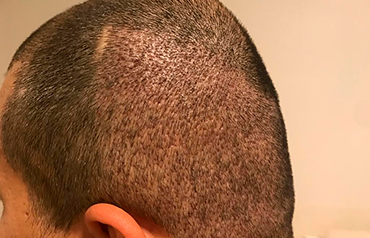
Eflúvio Telógeno após o Transplante Capilar pela técnica de Extração de Folicular (FUE)
Por Dra. Renata Lages Laughton
NOTA INTRODUTÓRIA
Por Dra. Tatiana Tournieux
“Nesse número, vamos falar sobre uma intercorrência rara mas que assusta muito, assusta não só o paciente mas como o cirurgião também!
Só de sabermos que ela existe, nos dá um alento importante, tanto para acalmar nossos corações, como para tranquilizar nossos pacientes!
Dra. Renata Lages nos presenteia com essa rica descrição de caso, para que o ‘shock loss’ esteja sempre no radar dos cirurgiões da restauração capilar.
Por fim, já antecipo a Conclusão desse importante relato de caso:
Apesar do número crescente de cirurgias de transplante capilar realizadas em todo o mundo, os estudos sobre complicações no pós-operatório ainda são escassos. Considero de extrema importância os relatos de casos como este, pois eles possibilitam não apenas a troca de experiências e o aprendizado técnico, mas também o respaldo jurídico diante dos desfechos inesperados que podem ocorrer em nossa prática cirúrgica.”
RESUMO
O Transplante Capilar (TC) tem sido cada vez mais indicado no tratamento da Alopecia Androgenética. Apesar do crescente número de cirurgias executadas em todo o mundo, existem poucos estudos sobre complicações/intercorrências no pós-operatório. Este artigo discorre sobre um caso de Eflúvio Telógeno (ET) importante em região doadora após o TC, e a maneira como o caso foi conduzido. O objetivo deste estudo é informar e orientar o cirurgião capilar sobre este possível desfecho no pós-operatório.
INTRODUÇÃO
O transplante capilar (TC) é um procedimento estético que vem ganhando popularidade nos últimos anos, principalmente com os avanços das técnicas cirúrgicas, que permitem resultados naturais, elegantes e rápida recuperação no pós-operatório.
Apesar de ser considerada uma cirurgia segura, complicações podem ocorrer após o TC pelas técnicas FUE ou FUT e isso representa um grande desafio para o cirurgião e para o paciente. Desfechos graves são relativamente incomuns, principalmente em cirurgias bem executadas,vpor equipe bem treinada, e devidamente planejadas.
As complicações podem ser na forma de queixas como dor pós-operatória, coceira, insatisfação com o resultado do procedimento ou complicações cirúrgicas como infecção, deiscência da ferida ou necrose da pele, entre outras.
Conhecer os desfechos mais comuns após a cirurgia de restauração capilar possibilita ao cirurgião uma maior segurança na execução do procedimento e melhor previsibilidade dos resultados.
RELATO DE CASO
Descrevo o caso de um paciente de 41 anos, submetido ao transplante capilar pela técnica FUE em maio de 2020. Paciente hígido, com quadro clínico e tricoscópico sugestivo de Alopecia Androgenética, sem demais alterações em couro cabeludo durante avaliação pré-operatória.
Na cirurgia foram extraídas 2300 unidades foliculares da região occipital e retroauricular, que foram transplantadas para o scalp médio e vértex
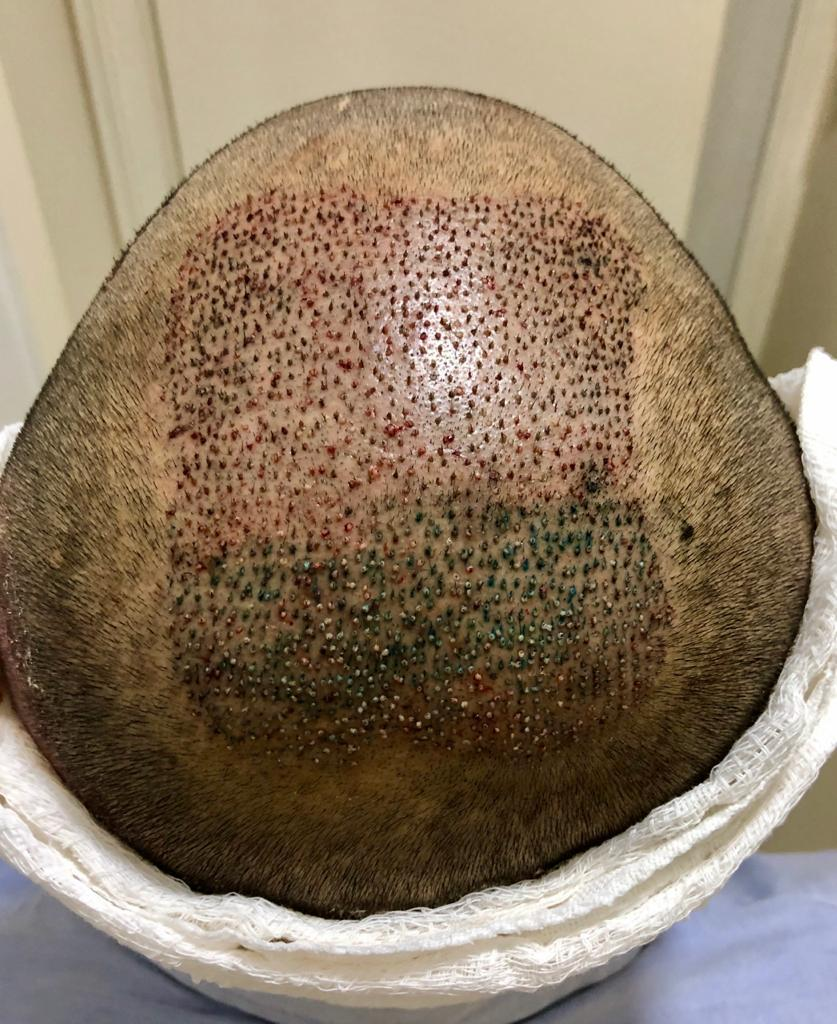
No seguimento fotográfico realizado na primeira semana, o paciente apresentou uma evolução satisfatória, cicatrização adequada dos enxertos e boa recuperação da região doadora
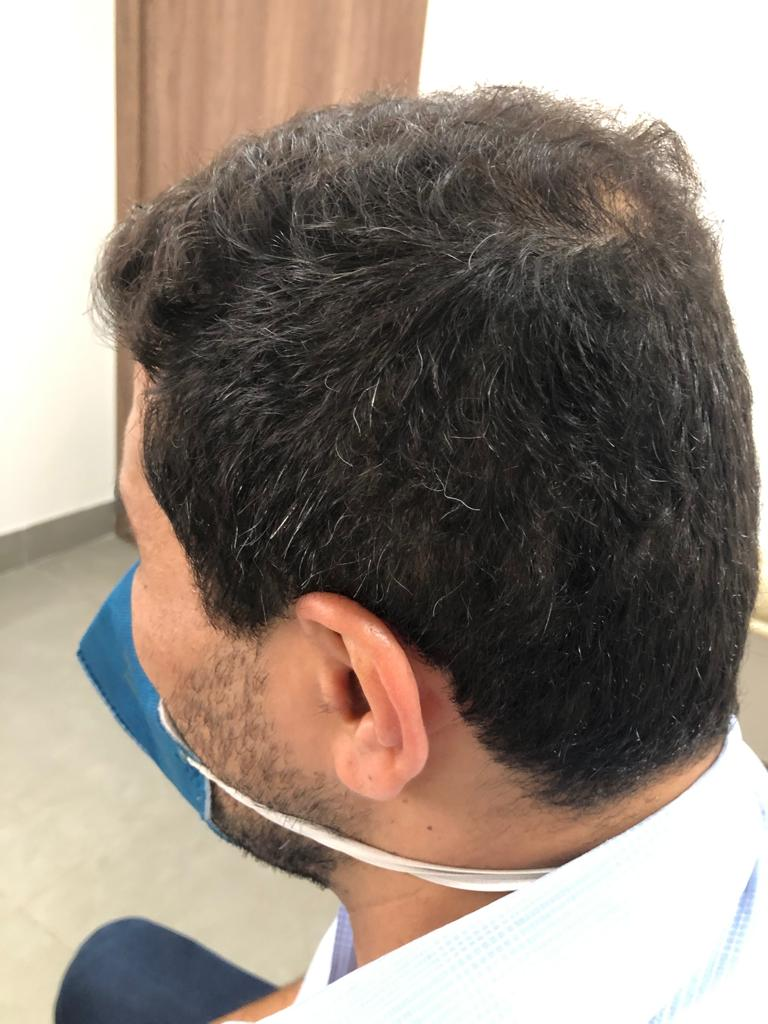
Vinte dias após a cirurgia, o paciente evoluiu com placas alopécicas em região doadora
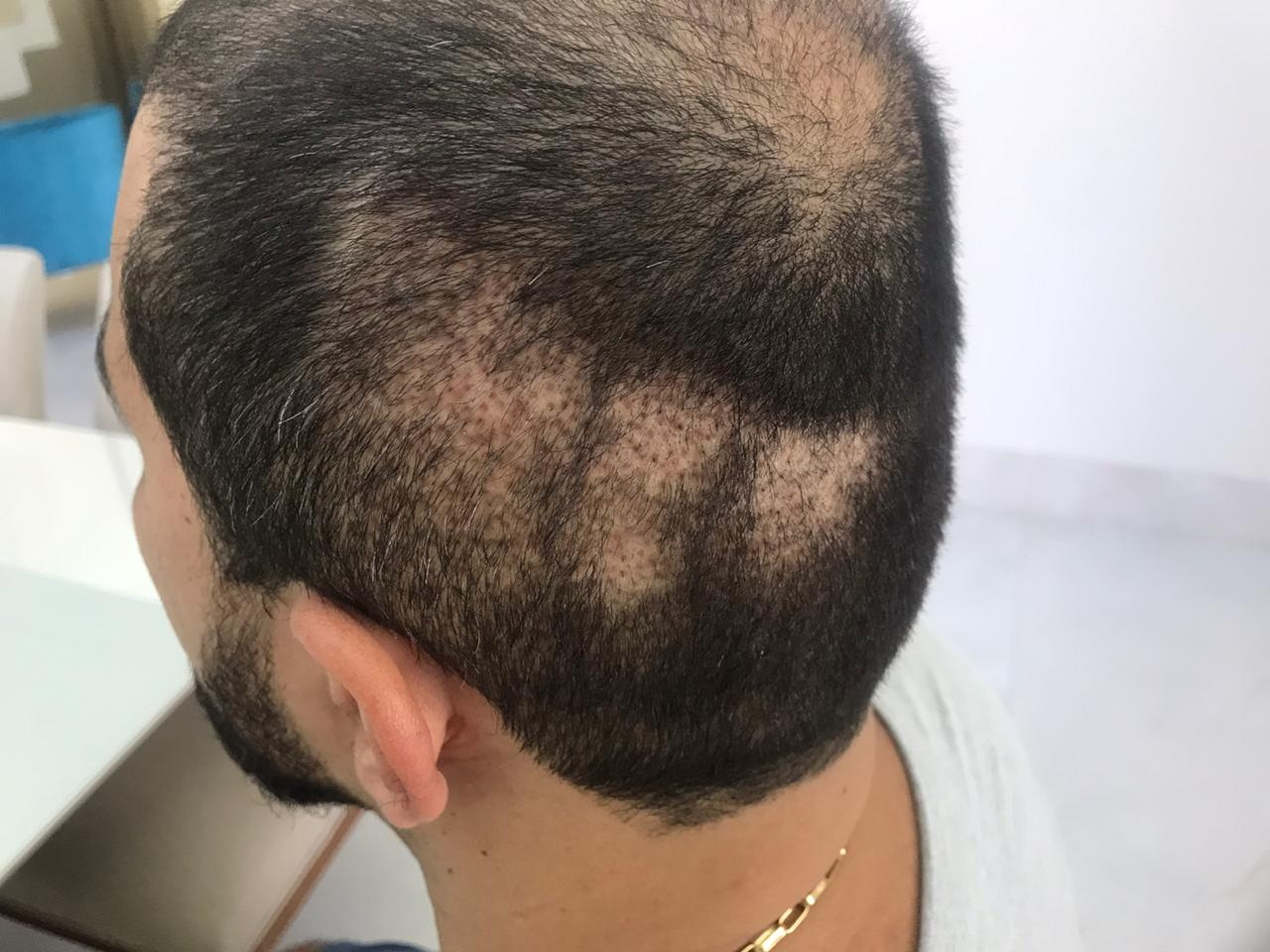
do couro cabeludo, assintomáticas, com piora progressiva das mesmas nas semanas subsequentes
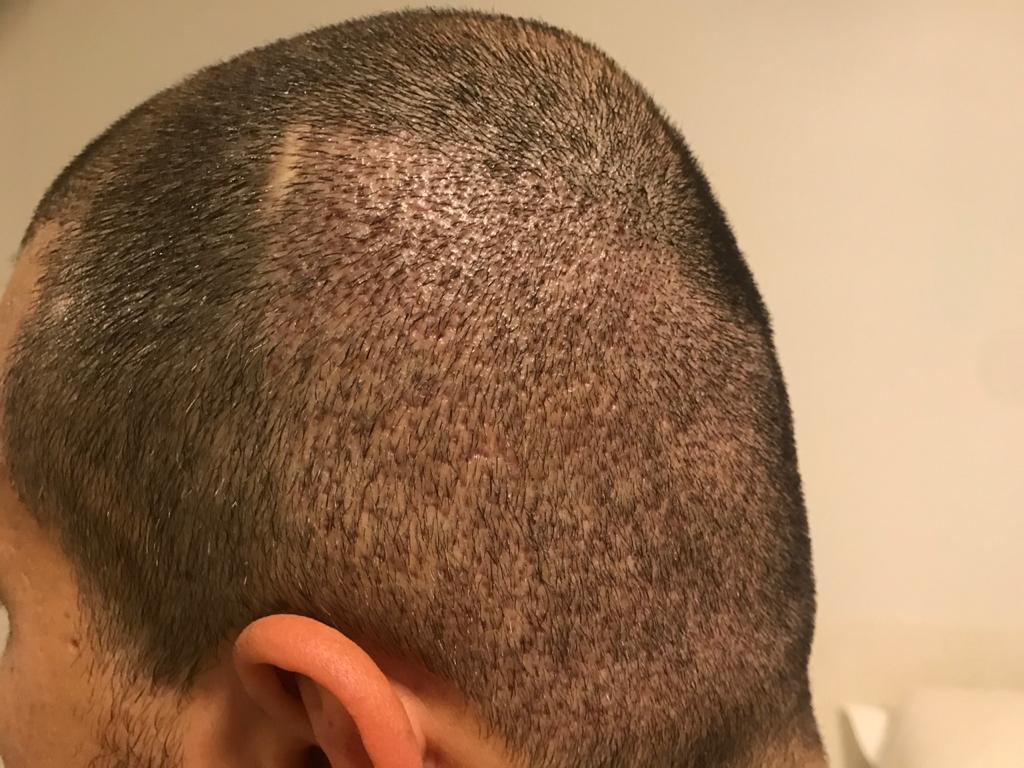
A tricoscopia das lesões revelou: lesões de aspecto não cicatricial, presença de black and yellow dots, ausência de sinais inflamatórios. Teste da tração negativa para fios anágenos.
Diante do quadro foi prescrito o uso tópico de Clobetasol gel 0,5% sobre as lesões à noite e laser capilar de baixa potência três vezes por semana. As medicações de uso prévio (Finasterida 1 mg VO ao dia e Minoxidil 2,5 mg VO ao dia) foram mantidas.
Após cerca de três meses o paciente apresentou repilação completa das lesões, sem recidivas do quadro após seguimento por dois anos
DISCUSSÃO
A cirurgia de transplante capilar possui baixo risco, é relativamente segura e tem incidência mínima de complicações. No entanto, é um fato bem aceito que nenhum procedimento da ciência médica existe sem qualquer risco potencial de complicações. A complicação pode ser uma queixa única na forma de dor, prurido, insatisfação com o resultado do procedimento, ou complicação cirúrgica na forma de infecção, deiscência da ferida ou necrose da pele.
Conhecer estes riscos incrementa nossa prática clínica e possibilita um maior domínio dos potenciais desfechos negativos. Além disso, conseguimos orientar melhor nossos pacientes e dividir com eles a responsabilidade do procedimento escolhido.
O Eflúvio Telógeno (ET) se refere ao quadro de queda capilar abrupta que pode ocorrer por várias causas, dentre elas a cirurgia de transplante capilar. A queda dos folículos recém transplantados é comum e esperada, e acredita-se que este fato ocorra pela interrupção súbita do aporte nutricional e oxigenação dos folículos no momento em que são extraídos da região doadora.
A perda excessiva de cabelo não transplantado existente na área receptora ocorre em média três a quatro semanas após o transplante, e pode ser causado por trauma direto nos folículos pilosos existentes, edema excessivo e trauma vascular durante a criação das incisões.
A queda dos folículos remanescentes da região doadora, por sua vez, é um evento raro, principalmente em tamanha proporção como no caso relatado. Existem poucos relatos sobre o tema; fatores como a quantidade de unidades foliculares extraídas, traumas durante a cirurgia, e soluções infiltradas durante o procedimento podem influenciar no surgimento deste evento.
Há que se chamar a atenção para o fato de que retirada excessiva de unidades foliculares na área doadora pode aumentar o risco de eflúvio telógeno na área doadora, além do risco de se exaurir a região no caso de não se fazer uma estimativa correta do potencial de retirada de folículos, algo que varia de paciente para paciente.
REFERÊNCIAS
1. David Perez-Meza, Robert Niedbalski, Complications in Hair Restoration Surgery, Oral and Maxillofacial Surgery Clinics of North America, Volume 21, Issue 1, 2009, Pages 119-148, ISSN 1042-3699.
2. Raymond J. Konior, Complications in Hair-Restoration Surgery, Facial Plastic Surgery Clinics of North America, Volume 21, Issue 3, 2013, Pages 505-520, ISSN 1064-7406.
3. Garg AK, Garg S. Complications of Hair Transplant Procedures-Causes and Management. Indian J Plast Surg. 2021 Dec 31;54(4):477-482. doi: 10.1055/s-0041-1739255. PMID: 34984088; PMCID: PMC8719980.
4. Salanitri S, Gonçalves AJ, Helene A Jr, Lopes FH. Surgical complications in hair transplantation: a series of 533 procedures. Aesthet Surg J. 2009 Jan-Feb;29(1):72-6. doi: 10.1016/j.asj.2008.11.005. PMID: 19233009.
RENATA LAGES LAUGHTON
DERMATOLOGISTA ESPECIALISTA EM TRICOLOGIA E TRANSPLANTE CAPILAR
MEMBRO DA SBD E ABCRC
CONTATO: [email protected]
English version
Telogen Effluvium after Hair Transplant using the Follicular Extraction (FUE) technique
Telogen Effluvium after Hair Transplant using the Follicular Extraction (FUE) technique
By Dra. Renata Lages Laughton
INTRODUCTION
By Dr. Tatiana Tournieux
“In this issue, we will cover a rare and scary complication; it scares not only the patient but also the surgeon!
knowing that it exists gives us an important breath, both to calm us and our patients!
Dr. Renata Lages presents us this rich case description, so that 'shock loss' is always on the radar of hair restoration surgeons.
Finally, I anticipate the conclusion of this important case report:
Despite the growing number of hair transplant surgeries performed worldwide, studies on postoperative complications are still scarce. Case reports like this are extremely important, as they allow not only the exchange of experiences and technical learning, but also legal support in the face of unexpected outcomes that may occur in our surgical practice.”
ABSTRACT
Hair Transplant (HT) has been increasingly indicated in the treatment of Androgenetic Alopecia. Despite the growing number of surgeries performed worldwide, there are few studies on postoperative complications. This article covers a case of significant Telogen Effluvium (TE) in the donor region after HT, and the way in which the case was conducted. This study aims at informing and guiding hair surgeons about this possible postoperative outcome.q
INTRODUCTION
Hair transplant (HT) is an aesthetic procedure that has been gaining popularity in recent years, with advances in surgical techniques, which allow for natural, elegant results and rapid postoperative recovery.
Despite being considered a safe surgery, complications can occur after HT using the FUE or FUT techniques and this represents a major challenge for both the surgeon and the patient. Severe outcomes are uncommon, especially in well-performed surgeries carried out by a well-trained and meticulously planned team.
Complications can be in the form of complaints such as postoperative pain, itching, dissatisfaction with the outcome of the procedure or surgical complications such as infection, wound dehiscence, or skin necrosis, among others.
Knowing the most common outcomes after hair restoration surgery gives the surgeon greater confidence in performing the procedure and better predictability of results
CASE REPORT
A 41-year-old patient who underwent hair transplantation using the FUE technique in May 2020. A healthy patient, with a clinical and trichoscopic condition suggesting an Androgenetic Alopecia, with no other changes in the scalp during the preoperative evaluation.
In the surgery, 2300 follicular units were extracted from the occipital and retroauricular region, which were transplanted to the middle scalp and vertex
In the photographic follow-up carried out in the first week, the patient presented a satisfactory evolution, adequate healing of the grafts and good recovery of the donor region
Twenty days after the surgery, the patient developed asymptomatic alopecic plaques in the donor region of the scalp, with progressive worsening in the subsequent weeks
Trichoscopy of the lesions revealed: non-scarring lesions, presence of black and yellow dots, absence of inflammatory signs. Negative pull test for anagen hair.
Due to this situation, topical use of Clobetasol gel 0.5% was prescribed on the lesions at night and low-power capillary laser three times a week. Previously used medications (Finasteride 1 mg orally daily and Minoxidil 2.5 mg orally daily) were maintained.
After about three months, the patient presented complete regrowth of the lesions, with no recurrences after two years of follow-up
DISCUSSION
Hair transplant surgery is minimal risk, safe, and has a minimal incidence of complications. However, it is a well-accepted fact that no procedure in medical science exists without any potential risk of complications. The complication may be a single complaint of pain, itching, dissatisfaction with the outcome of the procedure, or a surgical complication, such as infection, wound dehiscence, or skin necrosis.
Knowing these risks enhances our clinical practice and enables greater mastery of potential negative outcomes. In addition, we were able to better guide our patients and share responsibility for the chosen procedure with them.
Telogen Effluvium (TE) refers to the sudden hair loss that can occur due to several causes, including hair transplant surgery. Falling newly transplanted follicles is common and expected; it is believed that it happens due to the sudden interruption of the nutritional supply and oxygenation of the follicles when they are extracted from the donor region.
Excessive loss of existing non-transplanted hair in the recipient area occurs an average of three to four weeks after transplantation and can be caused by direct trauma to existing hair follicles, excessive edema, and vascular trauma during the creation of incisions.
Falling remaining follicles in the donor region, in turn, is a rare event, especially in such a considerable proportion as in the reported case. There are few reports on the subject; the number of follicular units extracted, trauma during surgery, and infiltrated solutions during the procedure may influence the appearance of this event.
You need to pay attention to the fact that excessive removal of follicular units in the donor area may increase the risk of telogen effluvium in the donor area, in addition to the risk of exhausting the region in case of not making a correct estimate of the potential for removal of follicles, something that varies from patient to patient.
CONCLUSION
Despite the growing number of hair transplant surgeries performed worldwide, studies on postoperative complications are still scarce. Case reports like this are extremely important, as they allow not only the exchange of experiences and technical learning, but also legal support in the face of unexpected outcomes that may occur in our surgical practice.
We must alert to the possibility of telogen effluvium in the donor area, as well as other complications through a very complete Informed Consent Form and informing the patient about these possibilities.
REFERÊNCIAS
1. David Perez-Meza, Robert Niedbalski, Complications in Hair Restoration Surgery, Oral and Maxillofacial Surgery Clinics of North America, Volume 21, Issue 1, 2009, Pages 119-148, ISSN 1042-3699.
2. Raymond J. Konior, Complications in Hair-Restoration Surgery, Facial Plastic Surgery Clinics of North America, Volume 21, Issue 3, 2013, Pages 505-520, ISSN 1064-7406.
3. Garg AK, Garg S. Complications of Hair Transplant Procedures-Causes and Management. Indian J Plast Surg. 2021 Dec 31;54(4):477-482. doi: 10.1055/s-0041-1739255. PMID: 34984088; PMCID: PMC8719980.
4. Salanitri S, Gonçalves AJ, Helene A Jr, Lopes FH. Surgical complications in hair transplantation: a series of 533 procedures. Aesthet Surg J. 2009 Jan-Feb;29(1):72-6. doi: 10.1016/j.asj.2008.11.005. PMID: 19233009.
RENATA LAGES LAUGHTON
DERMATOLOGIST SPECIALIST IN TRICOLOGY AND HAIR TRANSPLANTATION
MEMBER OF SBD AND ABCRC.
CONTATO: [email protected]

