
Por Dra. Karen Fernandes de Oliveira
Recentemente a Agência Nacional de Vigilância Sanitária (ANVISA) aprovou a inclusão em bula do Baricitinibe para o tratamento da Alopecia Areata grave em adultos no Brasil.
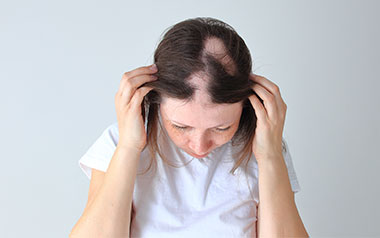
A alopecia areata (AA) é uma doença autoimune crônica, recidivante com componente genético, caracterizada por queda de cabelo inflamatória não cicatricial que pode afetar couro cabeludo, sobrancelhas, cílios, barba e pêlos do corpo. A apresentação clínica da AA é heterogênea. Sua patogênese envolve fatores imunológicos, genéticos e várias citocinas pró-inflamatórias, que sinalizam pela via da Janus quinase (JAK).
Em pacientes com AA grave, em que a perda de cabelo afeta pelo menos 50% do couro cabeludo, o tratamento é essencial, pois a remissão espontânea é rara. O tratamento para AA visa interromper sua progressão e reverter a perda de cabelo, neste sentido, a inibição da via JAK demonstrou ser promissora no tratamento de AA em ensaios clínicos recentes.
Novos estudos (BRAVE-AA1 e BRAVE-AA2) demonstram que o Baricitinibe, um inibidor oral de JAK1 e JAK2, demonstrou ser eficaz no crescimento do cabelo após 36 semanas de tratamento em adultos com AA grave. Nesses estudos, os eventos adversos mais comuns foram infecções do trato respiratório superior, cefaleia, infecção do trato urinário, acne e elevação dos níveis da creatinafosfoquinase. Com base nestes resultados, o Baricitinibe foi recentemente aprovado pela Agência Europeia de Medicamentos (EMA), pela Food and Drug Administration (FDA) dos EUA e pela ANVISA no Brasil para o tratamento de adultos com AA grave.
Portanto, o Baricitinibe é uma alternativa terapêutica com ausências de efeitos colaterais graves até o momento e promissora para AA grave, embora estudos adicionais sejam necessários para avaliar sua eficácia e segurança a longo prazo.
Referências bibliográficas:
1. King B, Ohyama M, Kwon O, Zlotogorski A, Ko J, Mesinkovska NA, et al. Two Phase 3 Trials of Baricitinib for Alopecia Areata. N Engl J Med. 2022;386(18):1687–99.
2. Phan K, Sebaratnam DF. JAK inhibitors for alopecia areata: a systematic review and meta-analysis. J Eur Acad Dermatol Venereol. 2019;33(5):850–6.
3. Kwon O, Senna MM, Sinclair R, Ito T, Dutronc Y, Lin CY, Yu G, Chiasserini C, McCollam J, Wu WS, King B. Efficacy and Safety of Baricitinib in Patients with Severe Alopecia Areata over 52 Weeks of Continuous Therapy in Two Phase III Trials (BRAVE-AA1 and BRAVE-AA2). Am J Clin Dermatol. 2023 May;24(3):443-451.
English version
Baricitinib approved for the treatment of Alopecia Areata
Dr. Karen Fernandes de Oliveira
Recently, the Brazilian Health Surveillance Agency (ANVISA) approved the inclusion of Baricitinib in the package insert for the treatment of severe Alopecia Areata in adults in Brazil.
Alopecia areata (AA) is a chronic, relapsing autoimmune disease with a genetic component, characterized by non-scarring inflammatory hair loss that can affect the scalp, eyebrows, eyelashes, beard, and body hair. The clinical presentation of AA is heterogeneous. Its pathogenesis involves immunological, genetic factors and several pro-inflammatory cytokines, which signal through the Janus kinase (JAK) pathway.
In patients with severe AA, where hair loss affects at least 50% of the scalp, treatment is essential as spontaneous remission is rare. Treatment for AA aims to stop its progression and reverse hair loss. In this sense, inhibition of the JAK pathway has shown being promising in the treatment of AA in recent clinical trials.
New trials (BRAVE-AA1 and BRAVE-AA2) demonstrate that Baricitinib, an oral JAK1 and JAK2 inhibitor, has been shown to be effective in hair growth after 36 weeks of treatment in adults with severe AA. In these studies, the most common adverse events were upper respiratory tract infections, headache, urinary tract infection, acne, and elevated creatine phosphokinase levels. Based on these results, Baricitinib was recently approved by the European Medicines Agency (EMA), the US Food and Drug Administration (FDA) and ANVISA in Brazil for the treatment of adults with severe AA.
Therefore, Baricitinib is a therapeutic alternative with no serious side effects to date and promising for severe AA, although additional studies are needed to evaluate its long-term efficacy and safety.
Bibliographic references:
1. King B, Ohyama M, Kwon O, Zlotogorski A, Ko J, Mesinkovska NA, et al. Two Phase 3 Trials of Baricitinib for Alopecia Areata. N Engl J Med 2022;386(18):1687–99.
2. Phan K, Sebaratnam DF. JAK inhibitors for alopecia areata: a systematic review and meta-analysis. J Eur Acad Dermatol Venereol. 2019;33(5):850–6.
3. Kwon O, Senna MM, Sinclair R, Ito T, Dutronc Y, Lin CY, Yu G, Chiasserini C, McCollam J, Wu WS, King B. Efficacy and Safety of Baricitinib in Patients with Severe Alopecia Areata over 52 Weeks of Continuous Therapy in Two Phase III Trials (BRAVE-AA1 and BRAVE-AA2). Am J Clin Dermatol. 2023 May;24(3):443-451.

