
Comentário sobre artigo A texture-driven model for male baldness
Márcio André Volkweis
Dermatologista
Sócio ABCRC
Este artigo - A texture-driven model for male baldness ; acesse em https://lhf.impa.br/ftp/papers/sib2022.pdf -, fruto de um estudo desenvolvido pela Faculdade de Informática da UFRGS, dissertação de mestrado, é um trabalho que tenta aproximar o mundo virtual à medicina exercida no contexto da calvície.
Uma das dificuldades no dia a dia da tricologia e restauração capilar é tentar mostrar aos pacientes como seria a evolução da calvície ao longo do tempo, e assim conseguir provar a necessidade de tratamentos preventivos, ou mesmo justificar as estratégias de cirurgia capilar a serem tomadas.
Sabe-se de muitas variáveis que podem contribuir para uma melhor ou pior evolução: história familiar, idade de início dos sintomas, tratamentos realizados, resposta terapêutica, realização de procedimentos cirúrgicos. São muitos fatores que podem influenciar na aparência capilar ao longo dos anos.
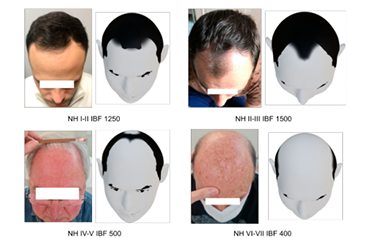
Este artigo propõe a construção de um modelo em 3D que mostra a evolução da calvície ao longo do tempo. Ele se baseou na escala Norwood-Hamilton, e na incidência e prevalência da alopecia androgenética de acordo com a idade de pacientes masculinos. Assim foi feito um modelo de evolução gráfica a perda de cabelo evoluiria ao longo do envelhecimento.
Este foi o primeiro passo. Antes, nada com base científica havia sido produzido. Agora, o objetivo é inserir nesta equação as variáveis que ajudem ou afetem a evolução do cabelo, auxiliando a prever graficamente as modificações capilares.
Não se sabe o quão fidedigno se mostrará este modelo nem mesmo a curto prazo. Mas com o aprimoramento do peso de cada característica envolvida na alopecia androgenética será possível aproximar de forma aceitável como será essa evolução.
Modelos gráficos, são equações matemáticas, com distintas variáveis, que podem ser equacionados para tentar imitar o desenvolvimento da vida. Apesar de imperfeitos, acredita-se que será possível aproximar-se muito da realidade, ajudando na tomada de decisões dos pacientes e médicos.
English version
A texture-driven model for male baldness
Comment on article A texture-driven model for male baldness
Márcio André Volkweis
Dermatologist
ABCRC Member
The article A texture-driven model for male baldness (https://lhf.impa.br/ftp/papers/sib2022.pdf) is the result of a study developed by the Faculty of Informatics of the Federal University of Rio Grande do Sul (UFRGS). A Master's dissertation trying to approach the virtual world to the medicine exercised in the context of baldness.
One of the difficulties in the daily routine of trichology and hair restoration is to try to show the patients how baldness would evolve over time, and thus be able to prove the need for preventive treatments, or even justify the hair surgery strategies to be taken.
We know many variables that can contribute to a better or worse evolution: family history, age of beginning of symptoms, treatments done, therapeutic response, accomplishment of surgical procedures. There are many factors that may influence the hair appearance along the years.
This article proposes the construction of a 3D model that shows the evolution of baldness over time. It was based on the Norwood-Hamilton scale, and on the incidence and prevalence of androgenetic alopecia according to the age of male patients. Thus a graphical evolution model was made of how hair loss would evolve with ageing.
This was the first step. Nothing with a scientific basis had been produced before. Now, the aim is to insert into this equation the variables that help or affect the evolution of hair, helping to graphically predict hair changes.
It is not known how reliable this model will prove to be, not even in the short term. But with the improvement of the weight of each characteristic involved in androgenetic alopecia it will be possible to approximate in an acceptable way how this evolution will be.
Graphical models are mathematical equations, with different variables, which can be equated to try to imitate the development of life. Although imperfect, it is believed that it will be possible to get very close to reality, helping in the decision-making of patients and doctors.

