
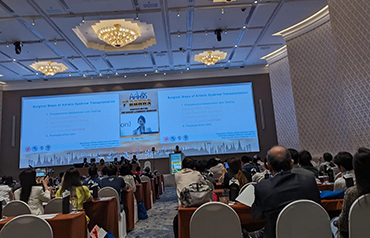
7th Asian Association of Hair Restoration Surgeons Scientific Meeting
Por Dra. Luciana Takata
Fotos por Aphakorn (Emily) Laochunsuwan, MD
No mês de julho, tive a oportunidade de participar da 7th AAHRS (Asian Association of Hair Restoration Surgeons) Scientific Meeting, que aconteceu em Bangkok, Tailândia. Gostaria de dividir com meus colegas da ABCRC alguns dos highlights desse evento.
Foi um evento que consistiu em um dia de hands on em cadáver, dois dias teóricos e um dia de live surgeries em hospital.
Infelizmente não estive presente no hands on em cadáver, mas ao conversar com colegas que participaram, o feedback foi muito positivo. Havia estações nas quais os participantes podiam testar os diversos aparelhos como o Trivellini Mamba, GraMAX II (do Dr. Jae Park) e o U Graft System (do Dr. Sanusi Umar), diferentes tipos de implanters, além de discutirem estratégia e técnica com grandes nomes como Dr. Jerry Wong e Dr. Dankerng Pathomvanich.
Com relação ao evento científico, as sessões foram divididas em: tratamento clínico, medicina regenerativa, tratamento não cirúrgico, instrumentos cirúrgicos, planejamento da área receptora, dicas práticas para o sucesso no transplante capilar, cirurgias na face, os diversos aparelhos de FUE, complicações, extração, aproveitamento da área doadora, maximizando resultados, FUT e free papers.
Nas aulas de tratamento clínico, algumas das minhas anotações.
Dr. Rattapon Thuangtong descreveu bons resultados em seus pacientes com a finasterida tópica em gel, a sua sugestão é iniciar a finasterida gel após dois anos de estabilização com o medicamento oral e observar a evolução. Dr. Poonkiat Suchonvanich falou sobre dutasterida oral x finasterida oral e, além de apresentar os últimos trabalhos, mostrou que em sua rotina inicia a dutasterida nos pacientes irresponsivos à finasterida nos últimos seis meses. Dr. Moonkyu Kim explicou que pacientes com piora da dermatite seborreica, após início da finasterida, melhoram após a troca pela dutasterida. A finasterida tem maior afinidade pela 5 alfa-redutase tipo ll, e sendo assim, a 5 alfa-redutase tipo l acaba sendo mais expressa, aumentando a seborreia. Como a dutasterida é 3 x mais potente em inibir a 5 alfa-redutase tipo ll e 100 x mais potente em inibir a tipo l, a troca dos medicamentos resolve o quadro.
Me chamou a atenção a sessão de medicina regenerativa, uma mesa com a participação do Dr. Ryan Welter, Dr. Jonh Cole, Dr. Ali Abbasi, Dr. Anil Garg e Dr. Jakub Miszcyk. Os colegas mostraram a importância desse assunto na atualidade e a necessidade de estudarmos mais profundamente a área. O folículo realmente envelhece mais rápido que a pele e as perspectivas do uso de exossomos, células tronco mesenquimais derivadas de tecido adiposo, PRP entre outros tratamentos parecem promissoras e abrem um enorme caminho a ser explorado dentro da nossa especialidade.
Achei bem interessante as aulas sobre hair line feminino asiático; Dr. Jae Park inclusive já escreveu um artigo incrível sobre o assunto e mostrou sua experiência e seus casos. Acredito que a cirurgia capilar feminina para restauração do contorno facial está em alta na Ásia, especialmente na Coreia do Sul, já que as pacientes querem ficar com um rosto mais ovalado e delicado como as famosas artistas de Dorama e KPop. Dessa forma, Dr. Jae Park mostrou o uso do seu aparelho GraMAXll, que tem um dispositivo de disparo no próprio dedo, e um punch chamado multi wave, que utiliza nas cirurgias non shaving e long hair FUE, técnicas cirúrgicas mais procuradas pelo público feminino da região. Ele opera esses casos com as pacientes sentadas e com rosto apoiado na frente como em uma cadeira de massagem, e as pacientes podem se distrair com o celular durante o procedimento.
Uma observação importante com relação ao body hair transplant: os fios corporais estão de 30 a 70% em fase telógena, então foi sugerido uso de minoxidil oral alguns meses antes da cirurgia e raspar os pêlos 3 dias antes do procedimento, para melhor visualização dos fios que estão em fase anágena.
Extremamente interessante uma aula do Dr. Kongkiat Laorwong sobre o uso de Matriz Dérmica Acelular (Mega fill) associado a PRP para levantar cicatrizes atróficas no couro cabeludo antes da FUE. Ela funciona como um substituto ao uso de gordura, com ótimos resultados.
Dr. Zhongxin Sun apresentou seus estudos com manipulação genética e uso de fios de porcos como opção de área doadora, sem necessidade de uso de imunossupressores!
Dr. Wen Yu Wu demonstrou em seu estudo que a finasterida seis meses antes da cirurgia de transplante capilar tem um efeito na área doadora significativa, melhorando o diâmetro e a densidade, ajudando durante o procedimento e no resultado final da cirurgia.
Dr. Tsevetalin Zarev apresentou uma aula sobre como realiza suas cirurgias FUE de 13.000 enxertos sem comprometimento cosmético da área doadora.
No jantar de gala tivemos o famoso e tradicional karaokê (com participação de todos os grandes palestrantes) e apresentação de dança típica tailandesa.
O live surgery workshop foi realizado no hospital universitário Chulalongkorn com demonstrações de cirurgia FUT, cirurgias FUE casos feminino e masculino, SMP e uso de terapia regenerativa.
Eu realmente gostei muito do meeting, extremamente bem organizado, e as aulas muito didáticas. Gostaria de deixar aqui meus agradecimentos à AAHRS, organizadores desse evento incrível e com certeza ano que vem tentarei participar novamente!
Dra. Luciana Takata Pontes
- Dermatologista, Clínica Ruston
- Membro ABCRC/ISHRS/
- Diplomata ABHRS
English version
7th Asian Association of Hair Restoration Surgeons Scientific Meeting
7th Asian Association of Hair Restoration Surgeons Scientific Meeting
By Dr. Luciana Takata
Photos by Aphakorn (Emily) Laochunsuwan, MD
In July, I had the opportunity to participate in the 7th AAHRS (Asian Association of Hair Restoration Surgeons) Scientific Meeting, held in Bangkok, Thailand. I will share with my ABCRC colleagues some of the highlights of this event.
The event had a day of hands-on classes cadavers, two theoretical days and a day of live surgeries in a hospital.
Unfortunately, I was not present at the practical classes, but when talking to colleagues, the feedback was positive. There were stations where participants could evaluate the various devices such as the Trivellini Mamba, GraMAX II (by Dr. Jae Park) and the U Graft System (by Dr. Sanusi Umar), several types of implants, in addition to discussing strategy and technique with names like Dr. Jerry Wong and Dr. Dankerng Pathomvanich.
Regarding the scientific event, the sessions were divided into clinical treatment, regenerative medicine, non-surgical treatment, surgical instruments, planning of the receiving area, practical tips for successful hair transplantation, facial surgeries, the various FUE devices, complications, extraction, use of the donor area, maximizing results, FUT and free papers.
In clinical treatment classes, I share some of my notes.
Dr. Rattapon Thuangtong described reliable results in his patients with topical finasteride gel, his suggestion is to start finasteride gel after two years of stabilization with the oral medication and observe the evolution. Dr. Poonkiat Suchonvanich spoke about oral dutasteride x oral finasteride and, in addition to presenting the latest works, he showed that in his routine he starts dutasteride in patients unresponsive to finasteride in the last six months. Dr. Moonkyu Kim explained that patients with worsening seborrheic dermatitis after starting finasteride improve after changing to dutasteride. Finasteride has a greater affinity for type ll 5 alpha-reductase, and therefore, type l 5 alpha-reductase is more expressed, increasing seborrhea. As dutasteride is three times more potent in inhibiting type ll 5 alpha-reductase and one hundred times more potent in inhibiting type l, changing the drugs resolves the situation.
The regenerative medicine session caught my attention, a table with Dr. Ryan Welter, Dr. Jonh Cole, Dr. Ali Abbasi, Dr. Anil Garg, and Dr. Jakub Miszcyk. Colleagues showed the importance of this subject today and the need to study the area more deeply. The follicle ages faster than the skin and the perspectives of using exosomes, mesenchymal stem cells derived from adipose tissue, PRP, among other treatments, seem promising and open a huge path to be explored within our specialty.
The classes on Asian woman hairline interesting; Dr. Jae Park even wrote an incredible article on the subject and showed his experience and cases. I believe that female hair surgery for facial contour restoration is on the rise in Asia, especially in South Korea, as patients want to have a more oval and delicate face like the famous Dorama and KPop artists. In this way, Dr. Jae Park showed the use of his GraMAXll device, which has a trigger device on his finger, and a punch called multi wave, which he uses in non-shaving and long hair FUE surgeries, surgical techniques most sought after by the female public in the region. He operates these cases with the patients seated and with their faces resting in front of them, as in a massage chair, and the patients can be distracted by their mobile phones during the procedure.
An important observation regarding the body hair transplant: 30 to 70% of the body hairs are in the telogen phase, so it was suggested to use oral minoxidil a few months before the surgery and to shave the hair three days before the procedure, for better visualization of the hairs in the anagen phase.
An extremely interesting class was given by Dr. Kongkiat Laorwong on the use of Acellular Dermal Matrix (Mega fill) combined with PRP to lift atrophic scars on the scalp prior to FUE.
This technique works as a substitute for the use of fat, with impressive results.
Dr. Zhongxin Sun presented his studies with genetic manipulation and the use of pig threads as a donor area option, without needing immunosuppressants!
Dr. Wen Yu Wu demonstrated in his study that using finasteride six months before hair transplant surgery has a significant effect on the donor area, improving the diameter and density, helping during the procedure and the result of the surgery.
Dr. Tsevetalin Zarev gave a class on how he performs his FUE surgeries of 13,000 grafts without cosmetic compromise of the donor area.
At the gala dinner we had the famous and traditional karaoke (with the participation of all the great speakers) and a typical Thai dance presentation.
The live surgery workshop was held at Chulalongkorn University Hospital with demonstrations of FUT surgery, FUE surgery in both female and male cases, SMP and the use of regenerative therapy.
I really enjoyed the meeting; it was extremely well organized, and the classes were very didactic. I would like to thank AAHRS, organizers of this incredible event. I will try to participate again next year!
Dr. Luciana Takata Pontes
- Dermatologist, Clínica Ruston
- Member ABCRC/ISHRS/
- ABHRS Diplomat

